For he who commands well, must at some time or other have obeyed.
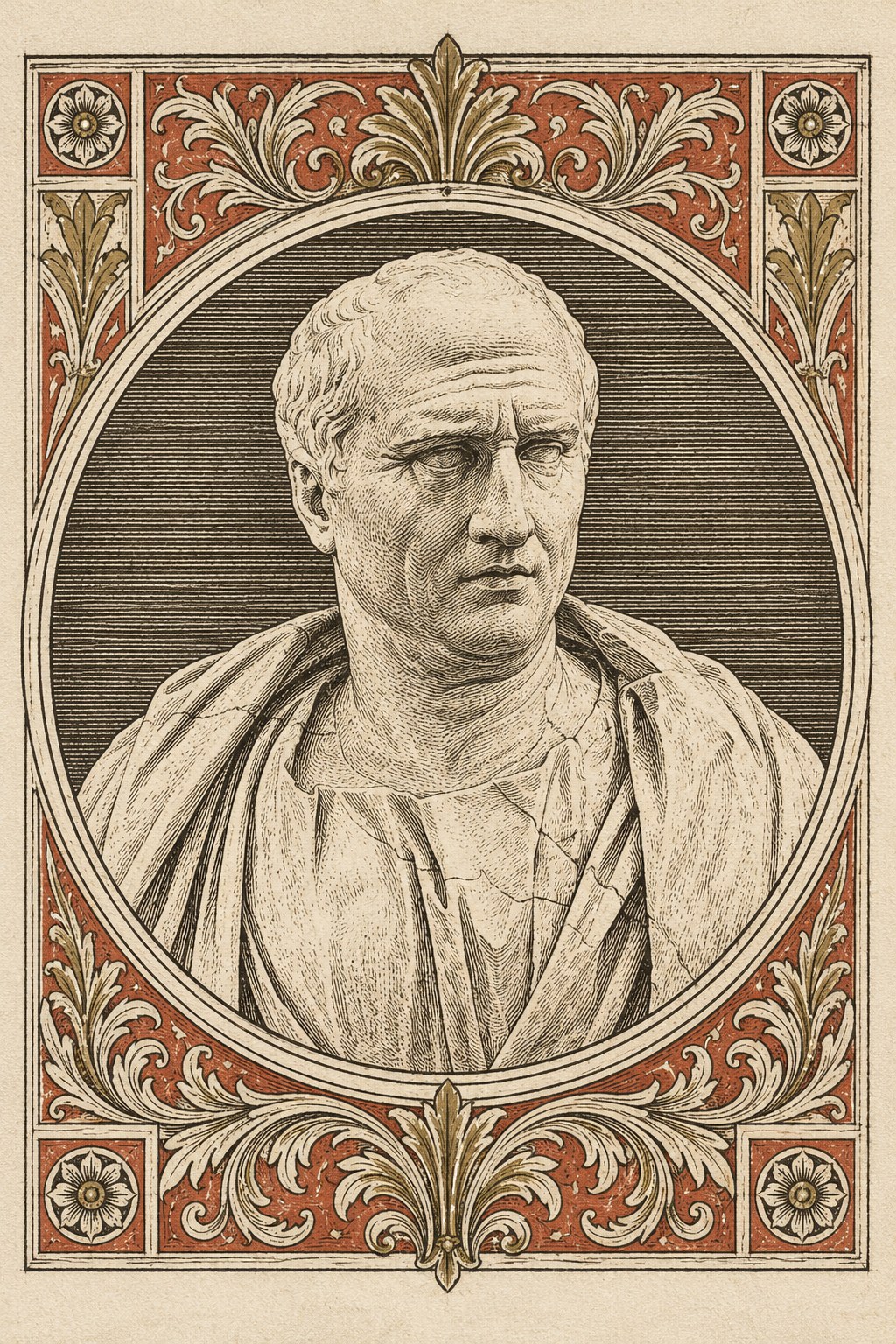
Genuine
Yes. In On the Laws (52 BC), Book III, chapter II, section 5 (De Legibus III.2.5), said by Marcus. These are the character’s words, not a statement in Cicero’s own voice.
Found word for word by program in the Latin original and in Charles Duke Yonge’s English translation (1853).
The wording people share differs slightly from the text; the words in the text are underlined below.
- Work
- On the Laws (De Legibus), 52 BC
- Where
- Book III, chapter II, section 5 (De Legibus III.2.5)
- Found at
- Paragraph 270 of the Latin text, 17 of the English
- Translation
- Charles Duke Yonge, 1853
Researched by AI; checked by program against the full text on 29 November 2026. Editorial review: pending. How we check
On the page
For ourselves, then, as we are proposing laws for a free people, and as we have already set forth in six books all our own, opinions about the best kind of commonwealth, we shall on the present occasion endeavour to accommodate our laws to that constitutional government of which we have expressed our approval.
[…] Nos autem quoniam leges damus liberis populis, quaeque de optima re publica sentiremus, in sex libris ante diximus, accommodabimus hoc tempore leges ad illum quem probamus civitatis statum.
It is clear, then, that magistrates are absolutely necessary; since, without their prudence and diligence, a state cannot exist; and since it is by their regulations that the whole commonwealth is kept within the bounds of moderation. But it is not enough to prescribe them a rule of domination, unless we likewise prescribe the citizens a rule of obedience. For he who commands well, must at some time or other have’ obeyed; and he who obeys with modesty appears worthy of some day or other being allowed to command.1 It is desirable, therefore, that he who obeys should expect that some day he will come to command, and that he who commands should: bear in mind that ere long he may be called to the duty of submission.
[5] Magistratibus igitur opus est, sine quorum prudentia ac diligentia esse civitas non potest, quorumque discriptione omnis rei publicae moderatio continetur. Neque solum iis praescribendus est imperandi, sed etiam civibus obtemperandi modus. Nam et qui bene imperat, paruerit aliquando necesse est, et qui modeste paret, videtur qui aliquando imperet dignus esse. Itaque oportet et eum qui paret sperare, se aliquo tempore imperaturum, et illum qui imperat cogitare, brevi tempore sibi esse parendum. […]
We would not, however, limit ourselves to requiring from the citizens submission and obedience towards their magistrates; we would also enjom them by all means to honour and love their rulers, as Charondas prescribes in his code. […]
Atticus: Mihi vero et istud et ordo iste rerum placet.
Atticus.—I certainly do please, and the arrangement seems advisable.
III [6] Marcus: ‘Justa imperia sunto, isque cives modeste ac sine recusatione parento. […]
The scene
Before presenting his proposed laws for magistrates, Marcus explains that a free commonwealth requires rules both for those who command and for citizens who obey. He links fitness to command with experience of obedience. The next sentence makes the reciprocity explicit: the person obeying should hope to command in turn, while the person commanding should remember that obedience will soon be required of him.
What it means
The ability to exercise authority well depends on having occupied the position of someone subject to it. In a free polity, ruling and being ruled are reciprocal roles.
Often misread
A maxim about learning obedience can sound like praise of permanent subservience. Here it introduces laws for free people and the rotation of civic authority, not an argument that one group should always rule another.
Topics
Related quotes
- The safety of the people shall be the highest law.
- The means may be likened to a seed, the end to a tree; and there is just the same inviolable connection between the means and the end as there is between the seed and the tree. Mahatma Gandhi
- We may then lay down this rule of friendship--neither ask nor consent to do what is wrong.
- Some men have sought to become famous and renowned, thinking that thus they would make themselves secure against their fellow-men. If, then, the life of such persons really was secure, they attained natural good; if, however, it was insecure, they have not attained the end which by nature’s own prompting they originally sought. Epicurus
- one’s whole life must be spent in learning how to live, and, which may perhaps surprise you more, one’s whole life must be spent in learning how to die. Seneca the Younger
Sources
Cite it
Marcus Tullius Cicero, On the Laws (52 BC), Book III, chapter II, section 5 (De Legibus III.2.5), translated by Charles Duke Yonge (1853). Spoken by Marcus. Checked at Quotogeny, https://quotogeny.com/q/he-who-commands-well-must-have-obeyed/ (29 November 2026).
Have a different wording, or a source we missed? Check it or submit it.
Do you hold the rights to anything on this page? Tell us.
Checked by people
People who checked this entry against its source, under their own names. Their checks do not change the verdict: an editor reviews every entry.
Comments