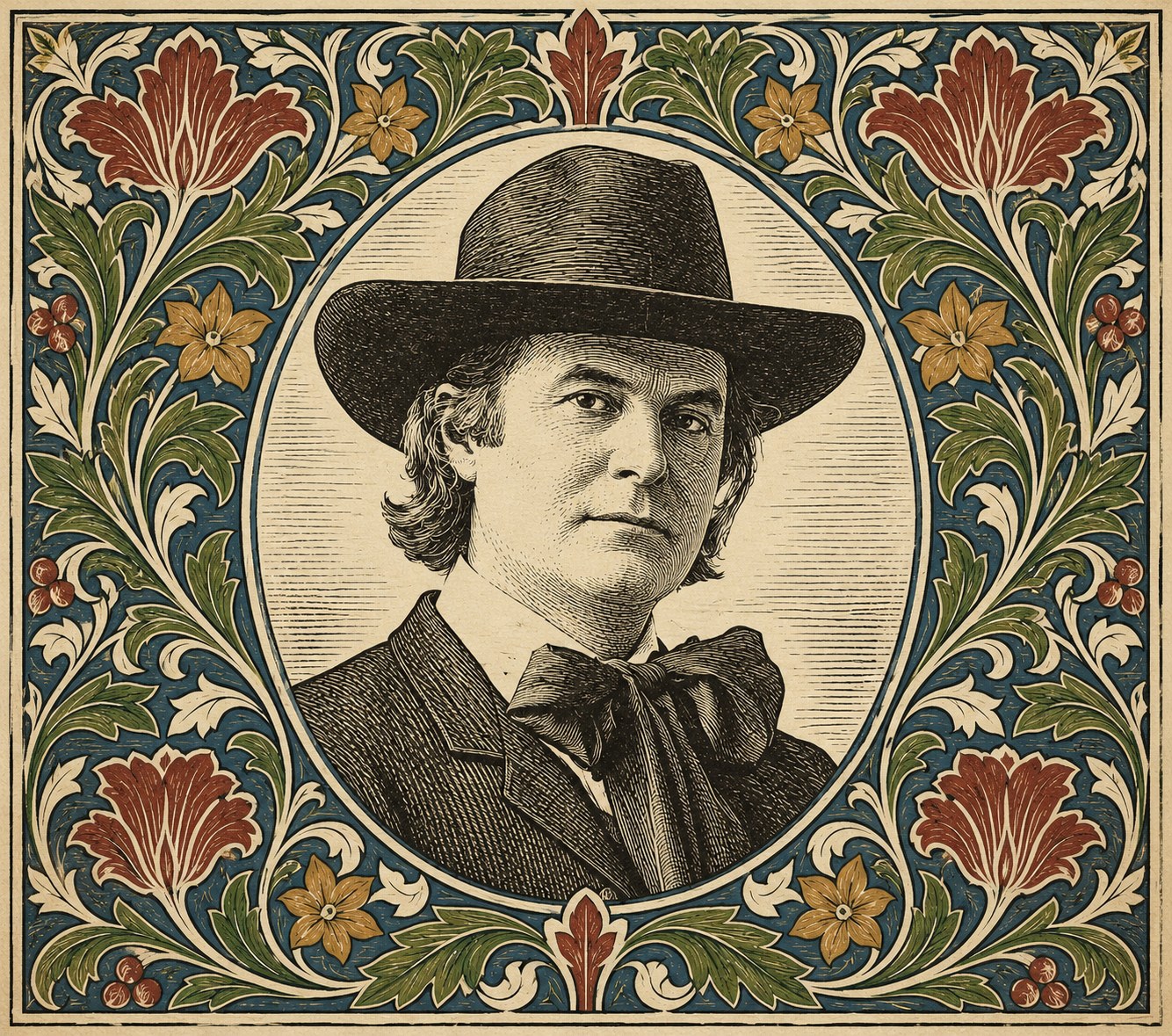
Elbert Hubbard
1856–1915
8 genuine quotes, each found in the text, and 5 wrongly credited to Hubbard.
American writer and publisher, born in Bloomington, Illinois, who founded the Roycroft arts-and-crafts community at East Aurora, New York, in 1895 and ran its press and its magazines, The Philistine and The Fra; he died with his wife on the Lusitania in 1915. He is best known for the essay ‘A Message to Garcia’ (1899) and for epigrams, which he printed by the hundred in his magazines and in mottoes and books of sayings, several of them compiled after his death. Some of the sayings credited to him reword lines that were already in circulation, and the internet credits him with wordings he never printed.
FrontispieceMade by an image model after James E. Purdy’s photograph of Elbert Hubbard (about 1905, public domain), in the manner of Arts and Crafts (1860–1920). The likeness is the original’s; this picture is AI‑generated and not historical. The endpaper behind it is an AI‑generated pattern in the same manner.

Genuine Hubbard quotes
- Do not take life too seriously. You will never get out of it alive.
Roycroft Dictionary and Book of Epigrams (1923), Roycroft Dictionary and Book of Epigrams (1923), Book of Epigrams, p. 105; first in The Philistine, December 1900, p. 24.
- The greatest mistake you can make in life is to be continually fearing you will make one.
The Philistine (1901), The Philistine, November 1901, p. 188 (among short sayings); later in the Roycroft Dictionary and Book of Epigrams (1923), p. 131, and The Note Book of Elbert Hubbard (1927), p. 129.
- Never explain — your friends do not need it and your enemies will not believe you anyway.
Fra Elbertus [Elbert Hubbard], The Motto Book; Being a Catalogue of Epigrams by Fra Elbertus, Assisted at Times by Solomon, Ruskin, Shakespeare, Joaquin Miller, Benjamin Franklin, Walt Whitman, Ali Baba and Felix Cyrenius (East Aurora: The Roycrofters, copyright 1909 by Elbert Hubbard), The Motto Book (1909), No. 127, p. 31; first, in another wording, on the cover of The Philistine, February 1904.
- An ounce of loyalty is worth a pound of cleverness.
A Message to Garcia (1899), ‘Horse Sense’, prefatory material in the 1914 edition of A Message to Garcia.
- Art is not a thing; it is a way.
Little Journeys to the Homes of the Great (1894), Volume 10, To the Homes of Great Teachers (Memorial Edition, 1916), ‘Thomas Arnold’, opening paragraph.
- Freedom cannot be bestowed — it must be achieved.
Little Journeys to the Homes of the Great (1894), To the Homes of Great Teachers, ‘Booker T. Washington’ (Memorial Edition, 1916), p. 207.
- The true teacher is a learner.
Little Journeys to the Homes of the Great (1894), Volume 10, To the Homes of Great Teachers (Memorial Edition, 1916), ‘Friedrich Froebel’, discussion of the young ‘school-mothers’.
- To teach is to influence, and influence never dies.
Little Journeys to the Homes of the Great (1894), Volume 10, To the Homes of Great Teachers (Memorial Edition, 1916), ‘Plato’, final paragraph.
Quotes wrongly credited to Hubbard
- A friend is someone who knows all about you and still loves you.
Misattributed. An unnamed ten-year-old schoolboy, quoted by Agnes Deans Cameron in ‘Humor in School’, The Century Magazine (April 1905) wrote it, not Hubbard.
- Life is just one damned thing after another.
Misattributed. No one knows who coined it: it was in print without a name from March 1909, and in a 1909 novel as a wall motto. The same year Hubbard’s Roycrofters sold it as a wall motto and The Philistine printed it unsigned; later books credited him.
- No man needs a vacation so much as the man who has just had one.
Misattributed. Hubbard used the quip in The Philistine in 1904 and helped spread it, but it was already called ‘an old saying’ in 1899; who first said it is unknown.
- The world is moving so fast these days that the man who says it can’t be done is generally interrupted by someone doing it.
Not found. This wording is credited to Hubbard in a later quotation collection, but no checked Hubbard text establishes it. Related sayings circulated earlier; the exact wording’s author remains uncertain.
- There is no defeat except from within. There is really no insurmountable barrier, save your own inherent weakness of purpose.
Misattributed. Robert Burns Wilson wrote it, not Hubbard.
Paraphrased: Hubbard’s thought, in other words
- To avoid criticism, say nothing, do nothing, be nothing.
Paraphrase. The idea is in Fra Elbertus [Elbert Hubbard], The Motto Book; Being a Catalogue of Epigrams by Fra Elbertus, Assisted at Times by Solomon, Ruskin, Shakespeare, Joaquin Miller, Benjamin Franklin, Walt Whitman, Ali Baba and Felix Cyrenius (East Aurora: The Roycrofters, copyright 1909 by Elbert Hubbard), p. 39, No. 202.
The works we hold
Quotes are looked up word for word in these texts. The number is how many genuine quotes here come from each.
| Work | Year | Genuine quotes |
|---|---|---|
| The Philistine The Philistine: A Periodical of Protest | 1895 | 1 |
| Little Journeys to the Homes of the Great Little Journeys to the Homes of Good Men and Great | 1894 | 4 |
| A Message to Garcia | 1899 | 1 |
| Roycroft Dictionary and Book of Epigrams | 1923 | 1 |