I was not born to be forced. I will breathe after my own fashion.
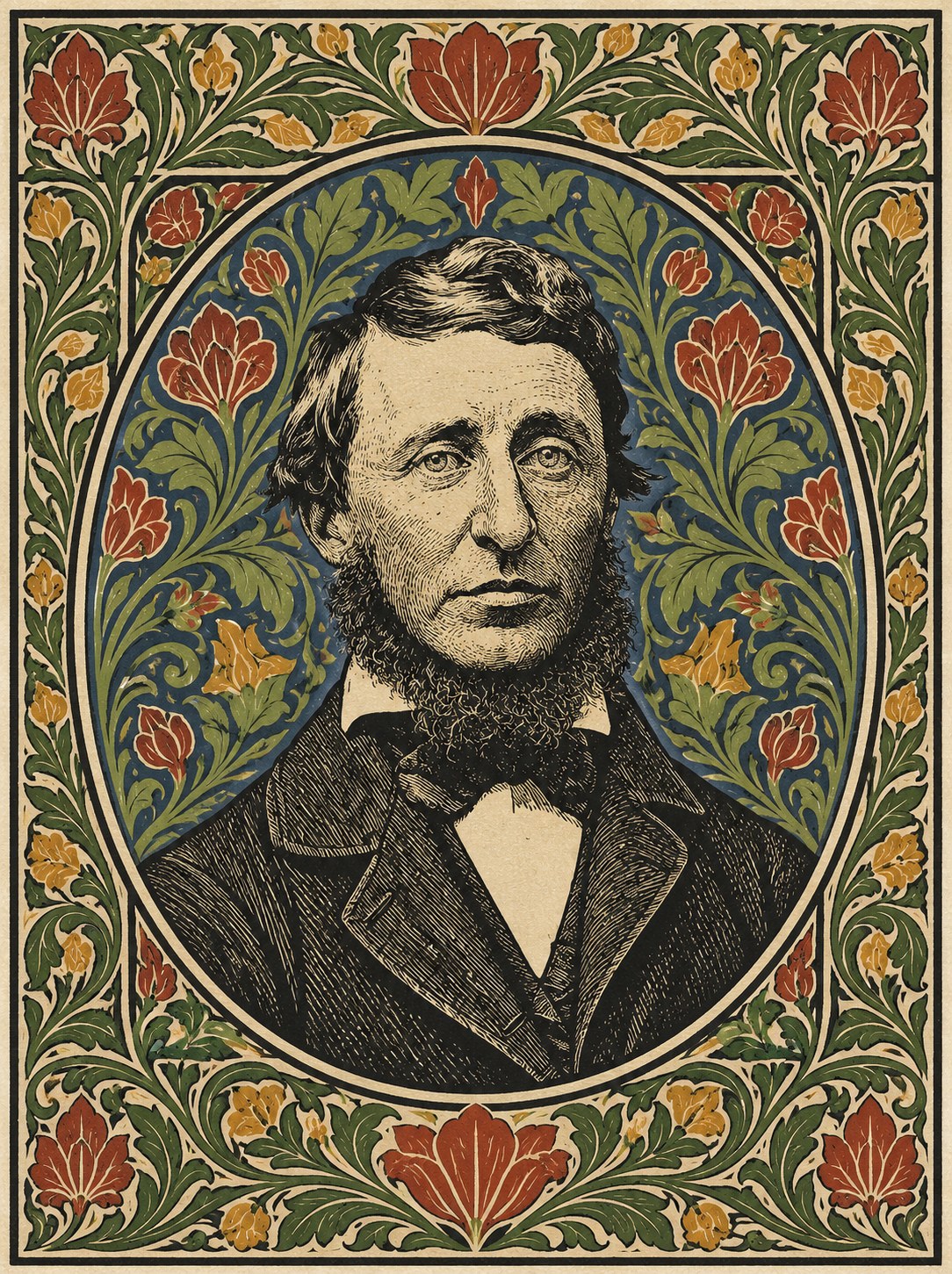
Genuine
Yes. In Civil Disobedience (1849), Aesthetic Papers (1849), p. 203; paragraph beginning ‘Thus the State never intentionally confronts a man’s sense,…’.
Found word for word by program in the full text.
Checked against Henry David Thoreau, ‘Resistance to Civil Government,’ Aesthetic Papers (1849), Art. X, p. 203, in a full-text transcription.
- Work
- Civil Disobedience (Resistance to Civil Government), 1849
- Where
- Aesthetic Papers (1849), p. 203; paragraph beginning ‘Thus the State never intentionally confronts a man’s sense,…’
- Found at
- Paragraph 12 of the text
- Source
- Henry David Thoreau, ‘Resistance to Civil Government,’ Aesthetic Papers (1849), Art. X, p. 203
- Checked
- In a full-text transcription
Researched by AI; checked by program against the full text on 29 November 2026. Editorial review: pending. How we check
On the page
[…] Is there not a sort of blood shed when the conscience is wounded? Through this wound a man’s real manhood and immortality flow out, and he bleeds to an everlasting death. I see this blood flowing now.
Thus the State never intentionally confronts a man’s sense, intellectual or moral, but only his body, his senses. It is not armed with superior wit or honesty, but with superior physical strength. I was not born to be forced. I will breathe after my own fashion. Let us see who is the strongest. What force has a multitude? They only can force me who obey a higher law than I. They force me to become like themselves. I do not hear of men being forced to live this way or that by masses of men. […]
The scene
Reflecting on his confinement for refusing the poll tax, Thoreau says the State could reach his body but not his judgment or conscience. He contrasts its physical strength with moral authority, then compares a person living according to his nature to an acorn or chestnut growing according to its own laws.
What it means
Physical coercion cannot supply a moral reason for obedience or make him surrender the direction of his own life.
Often misread
Often usable as a general declaration of independence, but in this essay the immediate issue is the State’s coercive claim on a conscientious tax refuser, not merely dislike of social expectations.
Topics
Related quotes
- Let your life be a counter friction to stop the machine.
- The right way to seize a philosopher, Crates, is by the ears: persuade me then and drag me off by them; but, if you use violence, my body will be with you, but my mind with Stilpo. Zeno of Citium
- Moreover, any man more right than his neighbors, constitutes a majority of one already.
- Under a government which imprisons any unjustly, the true place for a just man is also a prison.
- You may trod me in the very dirt But still, like dust, I’ll rise. Maya Angelou
Sources
Cite it
Henry David Thoreau, Civil Disobedience (1849), Aesthetic Papers (1849), p. 203; paragraph beginning ‘Thus the State never intentionally confronts a man’s sense,…’. Checked at Quotogeny, https://quotogeny.com/q/i-was-not-born-to-be-forced/ (29 November 2026).
Have a different wording, or a source we missed? Check it or submit it.
Do you hold the rights to anything on this page? Tell us.
Checked by people
People who checked this entry against its source, under their own names. Their checks do not change the verdict: an editor reviews every entry.
Comments