AI-generated · About the image
Set in the manner of Bauhaus, a style from Stylogeny. Einstein’s 1921 Berlin lecture distinguishes formal geometry from its empirical application. Bauhaus geometry gives that distinction a restrained graphic language from the same German interwar world; the house monospace is a practical substitute for its geometric sans within the available typefaces.
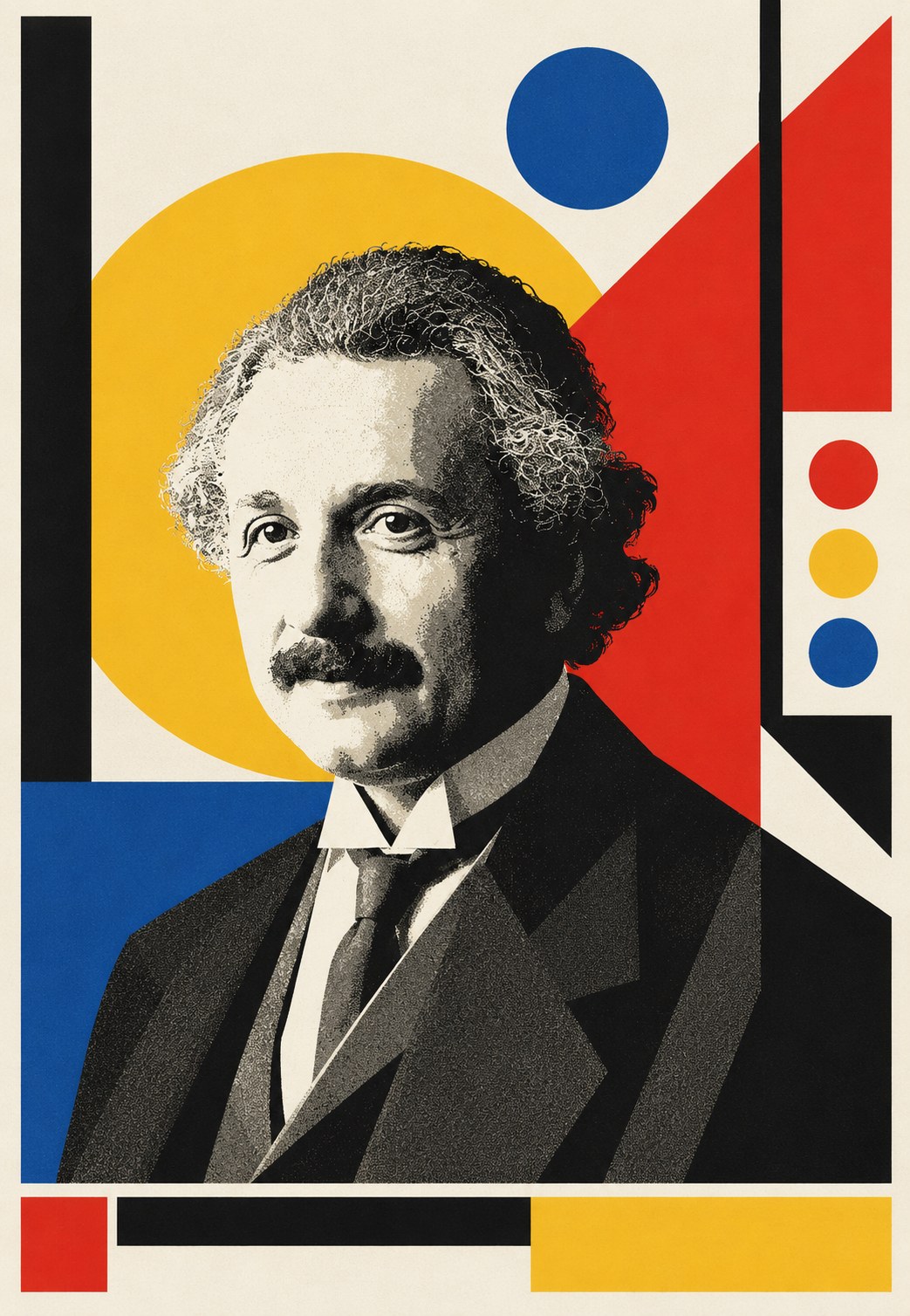
The picture is AI‑generated: not a historical work, and it holds no words of the quote. The small portrait beside the name is AI‑generated too, after a public-domain original named on the person’s page.
Insofar as the propositions of mathematics refer to reality, they are not certain; and insofar as they are certain, they do not refer to reality.
Genuine
Yes. In Albert Einstein, Geometrie und Erfahrung: Erweiterte Fassung des Festvortrages gehalten an der Preussischen Akademie der Wissenschaften zu Berlin am 27. Januar 1921 (Berlin: Julius Springer, 1921), pp. 3–4.
Checked against Albert Einstein, Geometrie und Erfahrung: Erweiterte Fassung des Festvortrages gehalten an der Preussischen Akademie der Wissenschaften zu Berlin am 27. Januar 1921 (Berlin: Julius Springer, 1921), pp. 3–4, in the text of a page scan, not the image.
- Where
- Geometrie und Erfahrung (Berlin: Julius Springer, 1921), pp. 3–4, opening discussion of mathematics and axioms
- Translation
- Our own, not yet reviewed (no public-domain translation in our sources)
- Source
- Albert Einstein, Geometrie und Erfahrung: Erweiterte Fassung des Festvortrages gehalten an der Preussischen Akademie der Wissenschaften zu Berlin am 27. Januar 1921 (Berlin: Julius Springer, 1921), pp. 3–4
- Checked
- In the text of a page scan, not the image
Researched by AI. Entry updated 8 November 2026. Editorial review: pending. How we check
About this quote
The scene
At the opening of his expanded 1921 Academy lecture, Einstein asks how mathematics, a product of thought, can fit physical reality so well. He answers by distinguishing formal certainty from claims about actual objects. The following discussion explains that axiomatic mathematics separates logical form from intuitive or empirical content, and then examines how geometrical axioms are interpreted.
What it means
Deduction can be certain within an axiomatic system; whether that system accurately describes the physical world is a further, empirical question.
Often misread
This does not say that mathematics is useless or that reality cannot be known. It distinguishes logical validity from the empirical applicability of a mathematical description.
Topics
Related quotes
- The person who is everywhere is nowhere. Seneca the Younger
- More law, less justice. Marcus Tullius Cicero
- We are now facing a problem more of ethics than of physics. Bernard Baruch
- The lord whose is the oracle at Delphoi neither utters nor hides his meaning, but shows it by a sign. Heraclitus
- The sea is the purest and the impurest water. Heraclitus
Sources
Cite it
Albert Einstein, Albert Einstein, Geometrie und Erfahrung: Erweiterte Fassung des Festvortrages gehalten an der Preussischen Akademie der Wissenschaften zu Berlin am 27. Januar 1921 (Berlin: Julius Springer, 1921), pp. 3–4. Checked at Quotogeny, https://quotogeny.com/q/mathematics-certain-or-about-reality/ (8 November 2026).
Have a different wording, or a source we missed? Check it or submit it.
Do you hold the rights to anything on this page? Tell us.
Checked by people
People who checked this entry against its source, under their own names. Their checks do not change the verdict: an editor reviews every entry.
Comments