Often, the surest way to convey misinformation is to tell the strict truth.
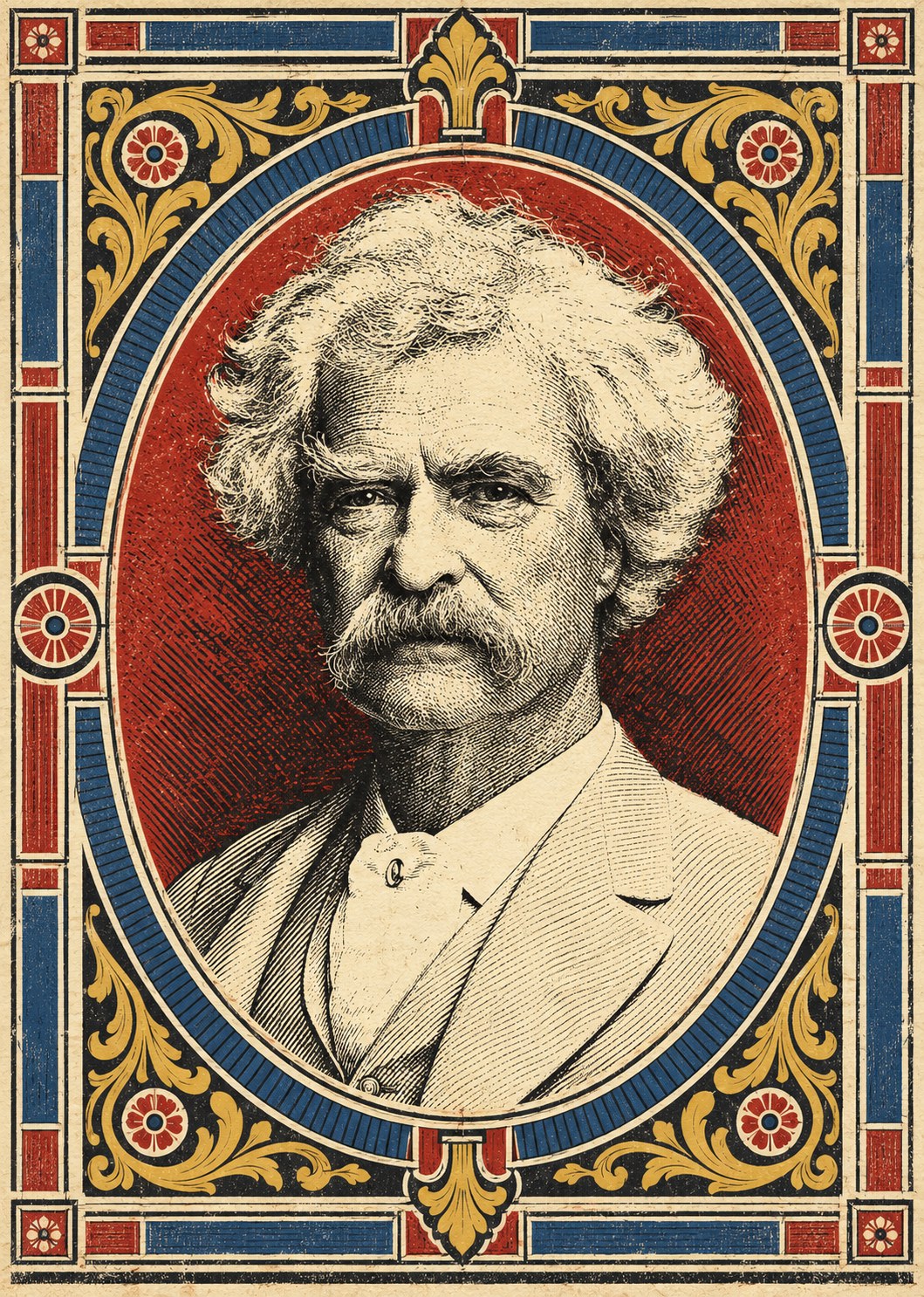
Genuine
Yes. In Following the Equator (1897), Chapter LIX, epigraph (Pudd’nhead Wilson’s New Calendar); repeated in the discussion of the Taj Mahal, said by Pudd’nhead Wilson. These are the character’s words, not a statement in Twain’s own voice.
Found word for word by program in the full text.
- Work
- Following the Equator, 1897
- Where
- Chapter LIX, epigraph (Pudd’nhead Wilson’s New Calendar); repeated in the discussion of the Taj Mahal
- Found at
- Paragraph 1901 of the text
Researched by AI; checked by program against the full text on 29 November 2026. Editorial review: pending. How we check
On the page
[…] Is it that paint cannot counterfeit the intense blaze of a sun-flooded jewel? There should be, and must be, a reason, and a good one, why the most enchanting sight that Nature has created has been neglected by the brush.
Often, the surest way to convey misinformation is to tell the strict truth.1 The describers of the Taj have used the word gem in its strictest sense—its scientific sense. In that sense it is a mild word, and promises but little to the eye—nothing bright, nothing brilliant, nothing sparkling, nothing splendid in the way of color. […]
These describers are writing for the “general,” and so, in order to make sure of being understood, they ought to use words in their ordinary sense, or else explain. […]
The scene
One of two calendar epigraphs opening chapter LIX of Following the Equator, the sentence returns in the same chapter during Twain’s discussion of the Taj Mahal. He explains that describing its decoration as gems can be technically accurate yet give ordinary readers a false idea of sparkling stones. Language and the reader’s imagination can produce a misleading picture even when the individual words are true.
What it means
Literal accuracy is not enough: a description may be true in a specialist sense while misleading the audience that actually reads it.
Often misread
This is a warning about misleading communication, not a claim that truth and falsehood are identical. The example turns on the different meanings an expert and an ordinary reader give the same word.
Topics
Related quotes
- If you don’t read the newspaper, you are uninformed; if you do read the newspaper, you are misinformed. (not found)
- Nothing is so firmly believed, as what we least know. Michel de Montaigne
- Beware of his false knowledge : it is more dangerous than ignorance. George Bernard Shaw
- Most often, what we seek in life is something to be stubborn about, not to learn from. André Gide
- Everything has already been said; but as no one listens, one must always begin again. André Gide
Sources
Cite it
Mark Twain, Following the Equator (1897), Chapter LIX, epigraph (Pudd’nhead Wilson’s New Calendar); repeated in the discussion of the Taj Mahal. Spoken by Pudd’nhead Wilson. Checked at Quotogeny, https://quotogeny.com/q/surest-way-to-convey-misinformation-is-to-tell-the-strict-truth/ (29 November 2026).
Have a different wording, or a source we missed? Check it or submit it.
Do you hold the rights to anything on this page? Tell us.
Checked by people
People who checked this entry against its source, under their own names. Their checks do not change the verdict: an editor reviews every entry.
Comments