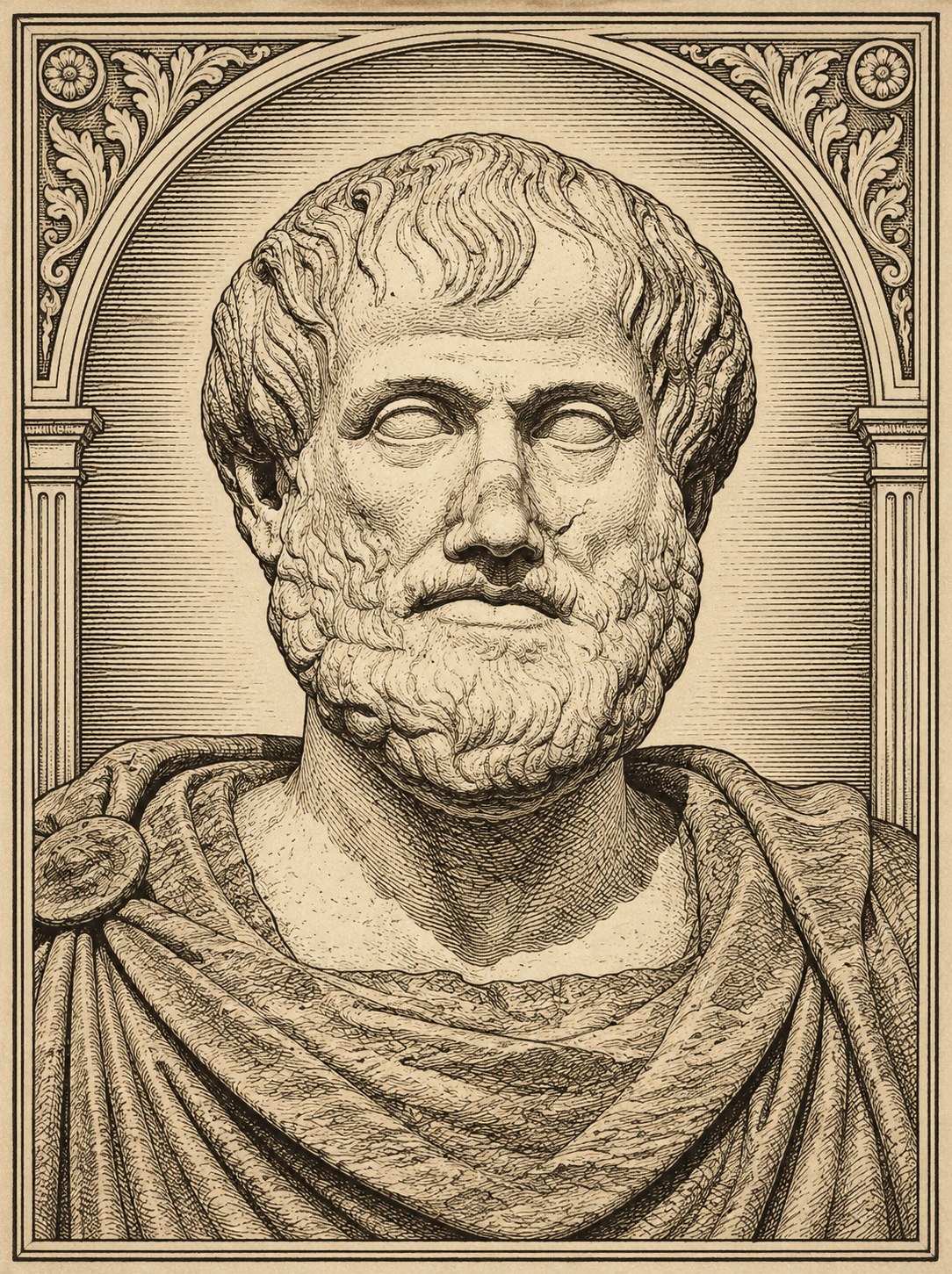
Aristotle
384–322 BC. Ἀριστοτέλης
7 genuine quotes, each found in the text, and 5 wrongly credited to Aristotle.
Greek philosopher from Stagira, a pupil of Plato and tutor of Alexander the Great, who founded his own school, the Lyceum, in Athens. His surviving works are mostly lecture treatises on logic, nature, ethics, politics and poetry, terse and qualified, so the polished one-liners credited to him online are usually later summaries or not his at all.
FrontispieceMade by an image model after an unknown Roman sculptor’s marble bust of Aristotle, after a bronze by Lysippos (1st or 2nd century AD, public domain), in the manner of the emblem books (1531–1724). The likeness is the original’s; this picture is AI‑generated and not historical. The endpaper behind it is an AI‑generated pattern in the same manner.

Genuine Aristotle quotes
- It is not one swallow or one fine day that makes a spring
Nicomachean Ethics (330 BC), Book I, chapter 7, 1098a18–20 (chapter V in D. P. Chase).
- A friend is another self.
Nicomachean Ethics (330 BC), Book IX, chapter 4 (1166a31, chapter IV in D. P. Chase).
- Happiness is a kind of working of the soul in the way of perfect Excellence
Nicomachean Ethics (330 BC), Book I, chapter 13 (Chase: Book I, chapter XI).
- Virtue is a mean state; but in reference to the chief good and to excellence it is the highest state possible.
Nicomachean Ethics (330 BC), Book II, chapter 6 (Chase: Book II, chapter VI).
- we are enquiring not merely that we may know what virtue is but that we may become virtuous
Nicomachean Ethics (330 BC), Book II, chapter 2 (Chase: Book II, chapter II).
- what we have to make when we have learned how, these we learn how to make by making.
Nicomachean Ethics (330 BC), Book II, chapter 1, 1103a–b (chapter I in D. P. Chase).
- no one would choose to live without friends.
Nicomachean Ethics (330 BC), Book VIII, chapter 1, 1155a5–6 (chapter I in D. P. Chase).
Quotes wrongly credited to Aristotle
- The worst form of inequality is to try to make unequal things equal.
Not found. It is not in Aristotle’s works, and who first wrote it is not known.
- We are what we repeatedly do. Excellence, then, is not an act, but a habit.
Misattributed. Will Durant wrote it, not Aristotle.
- Educating the mind without educating the heart is no education at all.
Not found. It is not in Aristotle’s works, and who first wrote it is not known.
- It is the mark of an educated mind to be able to entertain a thought without accepting it.
Not found. It is not in Aristotle’s works, and who first wrote it is not known.
- Knowing yourself is the beginning of all wisdom.
Not found. No source has been found for this sentence in Aristotle. It resembles the Delphic “know thyself”, but its wording and earliest printing remain untraced; related Aristotelian passages are not the same quotation.
Paraphrased: Aristotle’s thought, in other words
- Pleasure in the job puts perfection in the work.
Paraphrase. The idea is in Nicomachean Ethics (330 BC), Book X, chapter 4 (Chase: Book X, chapter IV).
- Suffering becomes beautiful when anyone bears great calamities with cheerfulness, not through insensibility but through greatness of mind.
Paraphrase. The idea is in Nicomachean Ethics (330 BC), Book I, chapter 10 in the Bywater/Greek division (1100b; chapter VIII in D. P. Chase).
- To be angry is what any man can do, and easy: but to do these to the right person, in due proportion, at the right time, with a right object, and in the right manner, this is not as before what any man can do, nor is it easy.
Paraphrase. The idea is in Nicomachean Ethics (330 BC), Book II, chapter 9 (1109a, chapter IX in D. P. Chase).
- Happiness is the meaning and the purpose of life, the whole aim and end of human existence.
Paraphrase. The idea is in Nicomachean Ethics (330 BC), Book I, chapter 7 (Chase: Book I, chapters IV–V).
- Plato is dear to me, but dearer still is truth.
Paraphrase. The idea is in Nicomachean Ethics (330 BC), Book I, chapter 6, 1096a11–17 (chapter III in D. P. Chase).
The works we hold
Quotes are looked up word for word in these texts. The number is how many genuine quotes here come from each.
| Work | Year | Genuine quotes |
|---|---|---|
| Nicomachean Ethics Ἠθικὰ Νικομάχεια | 330 BC | 7 |
Aristotle on
- Morality 4 genuine quotes
- Life 3 genuine quotes
- Happiness 2 genuine quotes
- Friendship 2 genuine quotes
- Education 2 genuine quotes