Darkness cannot drive out darkness: only light can do that. Hate cannot drive out hate: only love can do that.
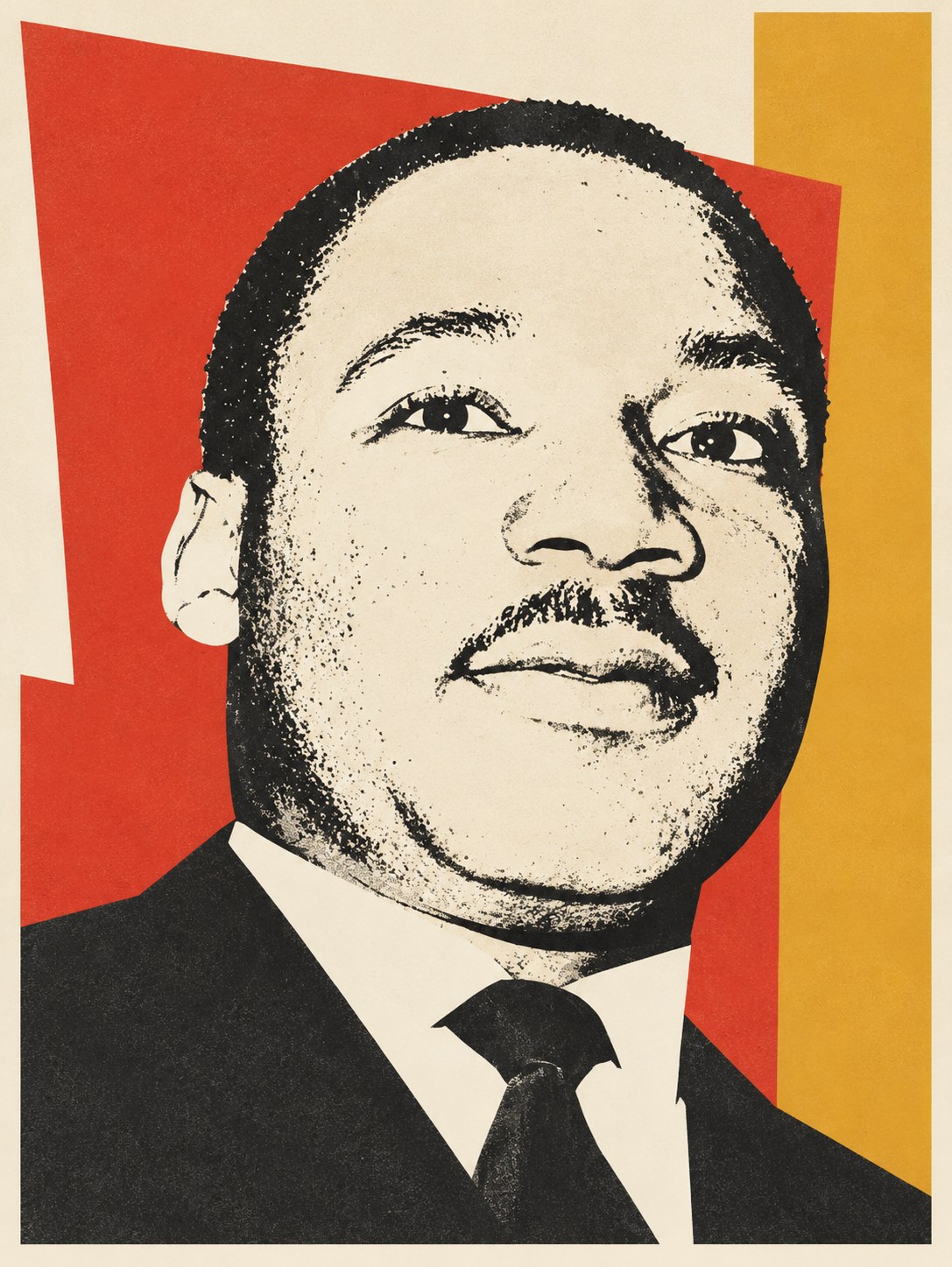
Genuine
Yes. In Strength to Love (1963), Sermon “Loving Your Enemies” (chapter V).
Checked against Martin Luther King, Jr., Strength to Love (New York: Harper & Row, 1963), chapter V, “Loving Your Enemies” (text: Matthew 5:43-45), p. 37, in the text of a page scan, not the image.
- Work
- Strength to Love, 1963
- Where
- Sermon “Loving Your Enemies” (chapter V)
- Source
- Martin Luther King, Jr., Strength to Love (New York: Harper & Row, 1963), chapter V, “Loving Your Enemies” (text: Matthew 5:43-45), p. 37
- Checked
- In the text of a page scan, not the image
Researched by AI. Entry updated 24 October 2026. Editorial review: pending. How we check
About this quote
The scene
A sermon on Jesus’s command ‘Love your enemies’ (Matthew 5:43-45); King had preached an earlier version at Dexter Avenue Baptist Church in Montgomery in November 1957, without these sentences in the surviving recording; they are first found in the 1963 book. He wrote this version while in a Georgia jail. After the practical ‘how’ (develop the capacity to forgive; see that the enemy’s evil deed never expresses all that he is; seek to win his friendship and understanding, not to defeat or humiliate him), King turns to the ‘theoretical why’, and this is his first reason. He goes on: the chain reaction of evil, hate begetting hate and wars producing more wars, must be broken or we will be plunged into annihilation; then come his other reasons, that hate scars the soul of the hater and that love is the only force capable of transforming an enemy into a friend.
What it means
Answering hate with hate only adds to it, as more darkness cannot dispel darkness; only love, like light, can end hatred, so someone has to break the cycle of retaliation by refusing to return it.
Often misread
Shared as a gentle saying that love wins in the end. In the sermon it is an argument for a hard command, loving one’s enemies, and for breaking a chain of retaliation that leads to destruction; and King used it as a reason for nonviolent resistance, not for passivity: in 1967 he quotes it again against the calls for retaliatory violence he heard in the Black Power movement, as a reason why nonviolence is the way to break the cycle of evil.
Also shared as
- Two passages run togetherI mourn the loss of thousands of precious lives, but I will not rejoice in the death of one, not even an enemy. Not King’s words: this is the detached first sentence of the May 2011 conflation already documented in this dossier. Eoin O’Carroll’s Christian Science Monitor article, 3 May 2011, reproduces this shortened wording as circulating under King’s name on Monday, 2 May, and identifies the first sentence as Jessica Dovey’s own introduction to a separately quoted King passage. It reproduces her original wording beginning “I will mourn”; quotation marks separating her words from King’s were lost in circulation. The Facebook post and the intervening copies were not inspected here: their history rests on contemporary reporting, corroborated by CBS News and Barry Popik. Do not treat this standalone sentence as an authentic King quotation. Where it was seen
- Two passages run togetherI will mourn the loss of thousands of precious lives, but I will not rejoice in the death of one, not even an enemy. … Darkness cannot drive out darkness; only light can do that. Hate cannot drive out hate, only love can do that. After the death of Osama bin Laden (May 2011) this went round Facebook and Twitter as all King’s. The first sentence was written by a Facebook user, who posted it followed by the King passage (which also began with his sentence on returning hate for hate, cut here) in quotation marks; someone copied it without the quotation marks, and on Twitter it was cut down to her sentence alone, as ‘I mourn the loss…’. Megan McArdle traced it in The Atlantic, 3 May 2011. Where it was seen
Before and after
A similar thought
- The Dhammapada: Verse 5 makes the same point in the Buddhist tradition: hatred is never ended by hatred.
Topics
Related quotes
- Let no one be slow to seek wisdom when he is young nor weary in the search thereof when he is grown old. For no age is too early or too late for the health of the soul. Epicurus
- The ultimate measure of a man is not where he stands in moments of comfort and convenience, but where he stands at times of challenge and controversy.
- We must remember that the future is neither wholly ours nor wholly not ours, so that neither must we count upon it as quite certain to come nor despair of it as quite certain not to come. Epicurus
- We are what we repeatedly do. Excellence, then, is not an act, but a habit. (misattributed) Aristotle
- Love is the only force capable of transforming an enemy into a friend.
Sources
- archive.org/details/strengthtolove0000king_f7v9 (Strength to Love, Harper & Row, 1963, p. 37; searched inside the scan)
- archive.org/details/wheredowegofromh00king (Where Do We Go from Here: Chaos or Community?, Harper & Row, 1967, pp. 62-63; searched inside the scan)
- kinginstitute.stanford.edu/king-papers/documents/loving-your-enemies-sermon-delivered-dexter-avenue-baptist-church (the 17 November 1957 Dexter Avenue sermon, transcribed from audio: same argument, ‘hate for hate only intensifies the existence of hate and evil in the universe’, but no darkness and light sentences)
- en.wikiquote.org/wiki/Martin_Luther_King_Jr. (files the passage under ‘Loving Your Enemies (Christmas 1957)’, said to be delivered at Dexter Avenue on 25 December 1957, from an online text that matches the 1963 book; the King Papers’ 17 November 1957 Dexter sermon lacks the lines, so that date is unsupported; also gives the 1967 book passage, p. 62, and the 2011 conflation under Misattributed)
- theatlantic.com/national/archive/2011/05/anatomy-of-a-fake-quotation/238257 (Megan McArdle, ‘Anatomy of a Fake Quotation’, 3 May 2011; read via the Wayback Machine)
- goodreads.com/quotes/943-darkness-cannot-drive-out-darkness-only-light-can-do-that (the circulating form, credited to A Testament of Hope; 78,754 likes on 21 October 2026)
Cite it
Martin Luther King Jr., Strength to Love (1963), Sermon “Loving Your Enemies” (chapter V). Checked at Quotogeny, https://quotogeny.com/q/darkness-cannot-drive-out-darkness/ (24 October 2026).
Have a different wording, or a source we missed? Check it or submit it.
Do you hold the rights to anything on this page? Tell us.
Checked by people
People who checked this entry against its source, under their own names. Their checks do not change the verdict: an editor reviews every entry.
Comments