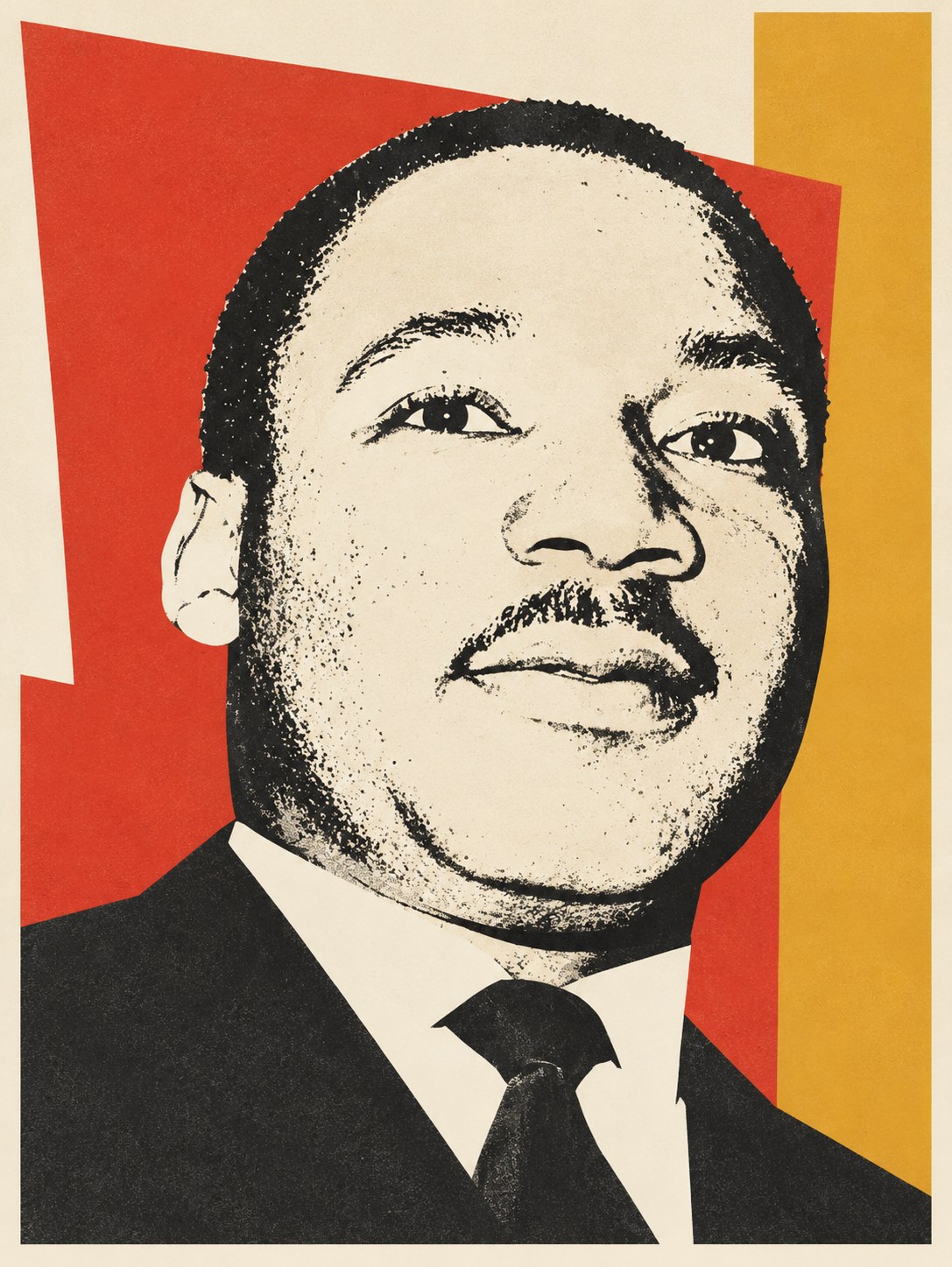
Martin Luther King Jr.
1929–1968
14 genuine quotes, each found in the text, and 2 wrongly credited to King.
American Baptist minister and leader of the civil rights movement, from the Montgomery bus boycott of 1955–56 to his assassination in Memphis in 1968; Nobel Peace Prize 1964. His best-known lines are his own, from sermons, speeches and books, but he reworked passages from one to the next, so a famous sentence can have several sources and wordings; the internet also credits him with sentences he never said.
FrontispieceMade by an image model after Phil Stanziola’s photograph of Martin Luther King Jr. (1964, public domain), in the manner of American mid-century modernism (1940–1970). The likeness is the original’s; this picture is AI‑generated and not historical. The endpaper behind it is an AI‑generated pattern in the same manner.

Genuine King quotes
- Darkness cannot drive out darkness: only light can do that. Hate cannot drive out hate: only love can do that.
Strength to Love (1963), Sermon “Loving Your Enemies” (chapter V).
- The arc of the moral universe is long, but it bends toward justice.
Martin Luther King, Jr., “A Look to the Future,” address delivered at Highlander Folk School’s Twenty-fifth Anniversary Meeting, Monteagle, Tennessee, 2 September 1957; King Papers, Stanford University, transcript from an audio recording, “A Look to the Future,” Highlander Folk School’s twenty-fifth anniversary meeting, Monteagle, Tennessee, 2 September 1957; concluding paragraph beginning “With all of these forces working together”.
- I have a dream that my four little children will one day live in a nation where they will not be judged by the color of their skin but by the content of their character.
I Have a Dream (1963), March on Washington for Jobs and Freedom, 28 August 1963; “I have a dream” sequence, after the Mississippi passage.
- everybody can be great, because everybody can serve.
A Testament of Hope (1986), The Drum Major Instinct, sermon at Ebenezer Baptist Church, Atlanta, 4 February 1968; collected in A Testament of Hope, section 43.
- We know through painful experience that freedom is never voluntarily given by the oppressor; it must be demanded by the oppressed.
Letter from Birmingham Jail (1963), letter of 16 April 1963, paragraph beginning “We know through painful experience”.
- Injustice anywhere is a threat to justice everywhere.
Letter from Birmingham Jail (1963), letter of 16 April 1963, paragraph beginning “Moreover, I am cognizant of the interrelatedness of all communities and states”.
- Love is the only force capable of transforming an enemy into a friend.
Strength to Love (1963), Strength to Love, chapter V, Loving Your Enemies; discussion of the third reason for loving enemies.
- the white moderate, who is more devoted to “order” than to justice; who prefers a negative peace which is the absence of tension to a positive peace which is the presence of justice;
Letter from Birmingham Jail (1963), 16 April 1963; paragraph beginning I must make two honest confessions to you.
- Power without love is reckless and abusive, and that love without power is sentimental and anemic.
A Testament of Hope (1986), Where Do We Go From Here?, address to the Southern Christian Leadership Conference, Atlanta, 16 August 1967; collected in A Testament of Hope, section 41.
- Shallow understanding from people of good will is more frustrating than absolute misunderstanding from people of ill will. Lukewarm acceptance is much more bewildering than outright rejection.
Letter from Birmingham Jail (1963), letter of 16 April 1963, end of the paragraph beginning “First, I must confess”.
Show all 14 genuine King quotesShow fewer
- the time is always ripe to do right.
Letter from Birmingham Jail (1963), 16 April 1963; paragraph on the misconception that time itself cures injustice.
- The ultimate measure of a man is not where he stands in moments of comfort and convenience, but where he stands at times of challenge and controversy.
Strength to Love (1963), Chapter III, On Being a Good Neighbor; passage on dangerous altruism.
- This “Wait” has almost always meant “Never.”
Letter from Birmingham Jail (1963), 16 April 1963; paragraph beginning For years now I have heard the word Wait.
- I believe that unarmed truth and unconditional love will have the final word in reality.
A Testament of Hope (1986), Nobel Peace Prize acceptance speech, University of Oslo, 10 December 1964; collected in A Testament of Hope, section 38.
Quotes wrongly credited to King
- Faith is taking the first step even when you don’t see the whole staircase.
Not found. The exact wording is unverified, not proved fake. Its evidence comes from Marian Wright Edelman’s posthumous recollections of King, first located by Quote Investigator in 1986, rather than a contemporary King text or recording.
- Our lives begin to end the day we become silent about things that matter.
Not found. This exact wording has not been authenticated as King’s. Clinton credited it to him in a speech on 30 April 2000, and it resembles King’s documented arguments about moral courage, but resemblance does not establish the words.
The works we hold
Quotes are looked up word for word in these texts. The number is how many genuine quotes here come from each.
| Work | Year | Genuine quotes |
|---|---|---|
| Strength to Love | 1963 | 3 |
| Letter from Birmingham Jail | 1963 | 6 |
| I Have a Dream | 1963 | 1 |
| A Testament of Hope A Testament of Hope: The Essential Writings of Martin Luther King, Jr. | 1986 | 3 |