Friendship can only exist between good men.
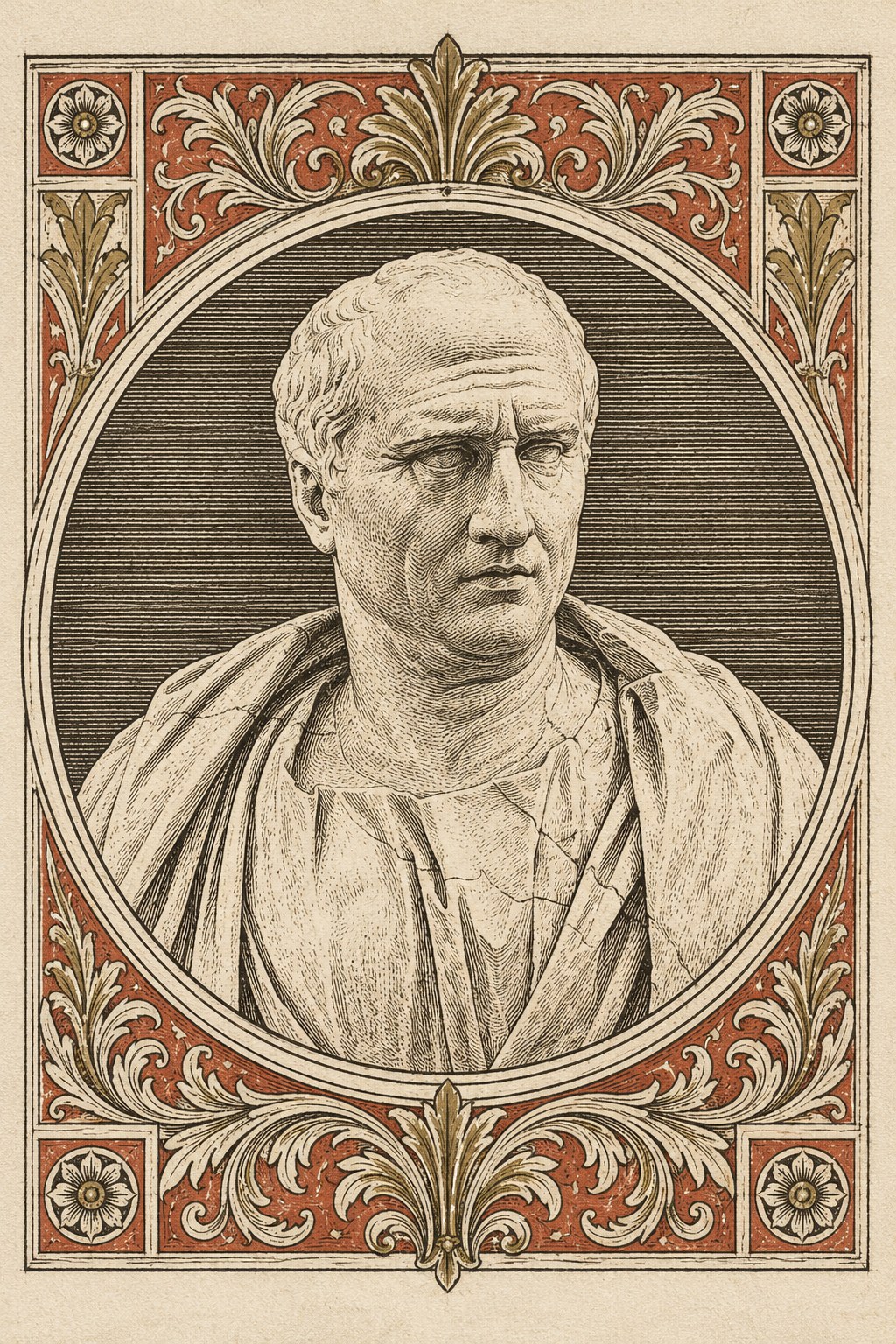
Genuine
Yes. In On Friendship (44 BC), Chapter V, section 18 (Laelius de Amicitia 5.18), said by Gaius Laelius. These are the character’s words, not a statement in Cicero’s own voice.
Found word for word by program in the Latin original and in E. S. Shuckburgh’s English translation.
- Work
- On Friendship (Laelius de Amicitia), 44 BC
- Where
- Chapter V, section 18 (Laelius de Amicitia 5.18)
- Found at
- Paragraph 22 of the Latin text, 17 of the English
- Translation
- E. S. Shuckburgh
Researched by AI; checked by program against the full text on 29 November 2026. Editorial review: pending. How we check
On the page
[…] All I can do is to urge on you to regard friendship as the greatest thing in the world; for there is nothing which so fits in with our nature, or is so exactly what we want in prosperity or adversity.
[…] Quam ob rem quae disputari de amicitia possunt, ab eis censeo petatis qui ista profitentur; ego vos hortari tantum possum ut amicitiam omnibus rebus humanis anteponatis; nihil est enim tam naturae aptum, tam conveniens ad res vel secundas vel adversas.
But I must at the very beginning lay down this principle—friendship can only exist between good men.1 I do not, however, press this too closely, like the philosophers who push their definitions to a superfluous accuracy. They have truth on their side, perhaps, but it is of no practical advantage. Those, I mean, who say that no one but the “wise” is “good.” […]
[18] Sed hoc primum sentio, nisi in bonis amicitiam esse non posse; neque id ad vivum reseco, ut illi qui haec subtilius disserunt, fortasse vere, sed ad communem utilitatem parum; negant enim quemquam esse virum bonum nisi sapientem. […]
We mean then by the “good” those whose actions and lives leave no question as to their honour, purity, equity, and liberality; who are free from greed, lust, and violence; and who have the courage of their convictions. […]
[19] Agamus igitur pingui, ut aiunt, Minerva. […]
Now this truth seems clear to me, that nature has so formed us that a certain tie unites us all, but that this tie becomes stronger from proximity. […]
[20] Quanta autem vis amicitiae sit, ex hoc intellegi maxime potest, quod ex infinita societate generis humani, quam conciliavit ipsa natura, ita contracta res est et adducta in angustum ut omnis caritas aut inter duos aut inter paucos iungeretur.
The scene
Asked by Fannius and Scaevola to speak about friendship after Scipio’s death, Laelius begins by making good character its condition. He immediately distinguishes ordinary, demonstrable honesty and fairness from the philosophers’ unattainable ideal of the perfectly wise man. His examples are people whom Romans actually regarded as good, not imaginary sages.
What it means
Full friendship needs people whose character can sustain mutual trust. Laelius means practicable goodness, not moral perfection.
Often misread
The sentence is not a claim that imperfect people cannot have friends. The qualification about ordinary goodness, rather than an ideal sage’s perfection, follows immediately; it is spoken by Laelius in Cicero’s dialogue.
Topics
Related quotes
- Now friendship may be thus defined: a complete accord on all subjects human and divine, joined with mutual goodwill and affection.
- Being good is the same as being a philosopher. Musonius Rufus
- A good life is equivalent to a just and honourable one. Plato
- the love of the everlasting possession of the good Plato
- Sometimes people use thought to not participate in life. Stephen Chbosky
Sources
Cite it
Marcus Tullius Cicero, On Friendship (44 BC), Chapter V, section 18 (Laelius de Amicitia 5.18), translated by E. S. Shuckburgh. Spoken by Gaius Laelius. Checked at Quotogeny, https://quotogeny.com/q/friendship-can-only-exist-between-good-men/ (29 November 2026).
Have a different wording, or a source we missed? Check it or submit it.
Do you hold the rights to anything on this page? Tell us.
Checked by people
People who checked this entry against its source, under their own names. Their checks do not change the verdict: an editor reviews every entry.
Comments