No one is so old as to think that he may not live a year.
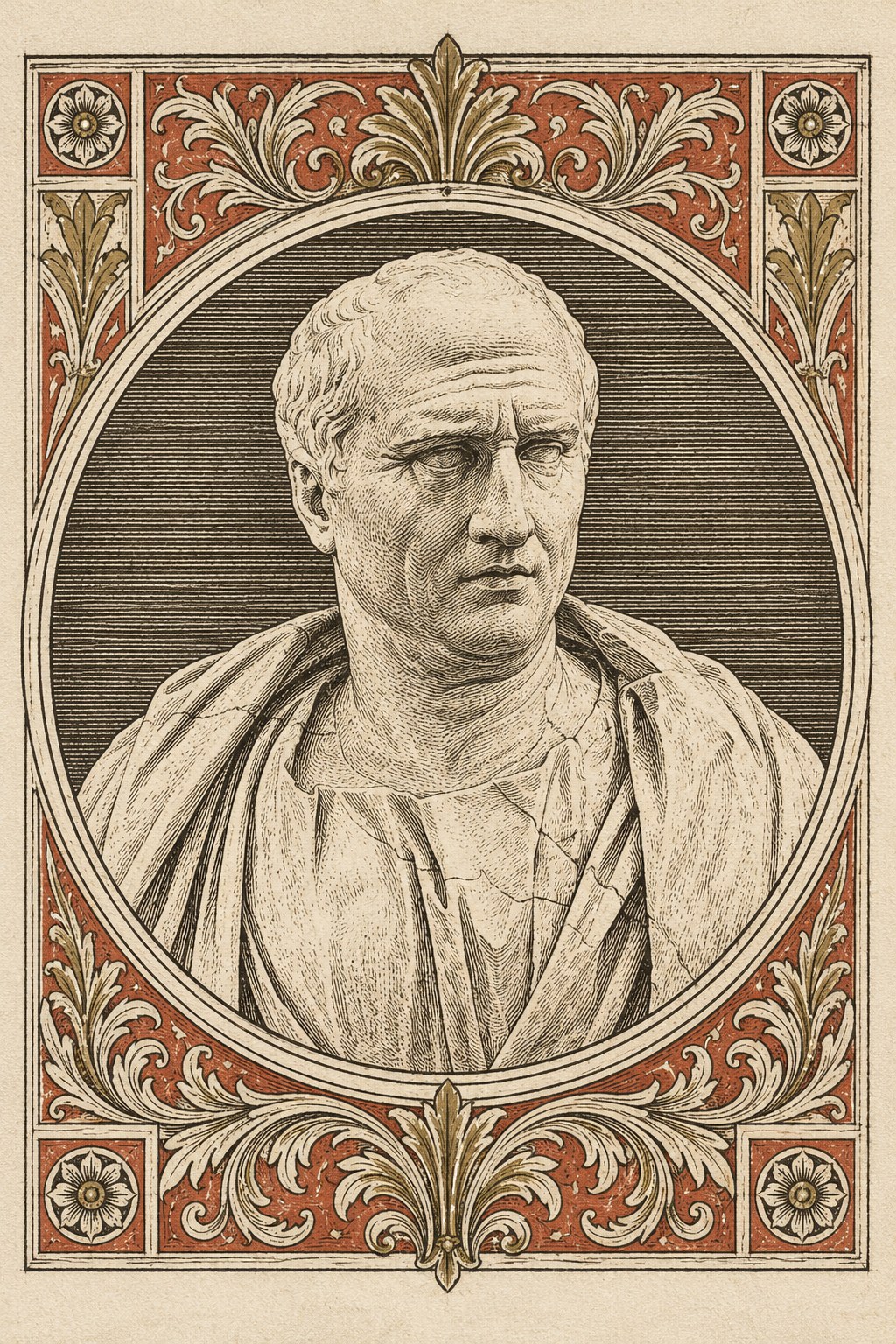
Genuine
Yes. In On Old Age (44 BC), Chapter VII, section 24 (Cato Maior de Senectute 7.24), said by Marcus Porcius Cato the Elder. These are the character’s words, not a statement in Cicero’s own voice.
Found word for word by program in the Latin original and in E. S. Shuckburgh’s English translation.
- Work
- On Old Age (Cato Maior de Senectute), 44 BC
- Where
- Chapter VII, section 24 (Cato Maior de Senectute 7.24)
- Found at
- Paragraph 45 of the Latin text, 34 of the English
- Translation
- E. S. Shuckburgh
Researched by AI; checked by program against the full text on 31 October 2026. Editorial review: pending. How we check
On the page
[…] Is it not rather the case with all these that the active pursuit of study only ended with life?
[…] An in omnibus studiorum agitatio vitae aequalis fuit?
But, to pass over these sublime studies, I can name some rustic Romans from the Sabine district, neighbours and friends of my own, without whose presence farm work of importance is scarcely ever performed—whether sowing, or harvesting or storing crops. And yet in other things this is less surprising; for no one is so old as to think that he may not live a year.1 But they bestow their labour on what they know does not affect them in any case:
24. Age, ut ista divina studia omittamus, possum nominare ex agro Sabino rusticos Romanos, vicinos et familiares meos, quibus absentibus numquam fere ulla in agro maiora opera fiunt, non serendis, non percipiendis, non condendis fructibus. Quamquam in aliis minus hoc mirum est; nemo enim est tam senex qui se annum non putet posse vivere: sed idem in eis elaborant quae sciunt nihil ad se omnino pertinere.
He plants his trees to serve a race to come,
Serit arbores, quae alteri saeclo prosint,
as our poet Statius says in his Comrades. […]
ut ait Statius noster in Synephebis.
The scene
Cato is answering the charge that old age cannot sustain useful work. He points to elderly Roman farmers from the Sabine countryside who still direct sowing, harvesting and storing crops. Their short-term labour is not surprising, since even an old person thinks another year possible; more striking is their planting of trees for a generation they will not see.
What it means
People continue to imagine a future for themselves even at an advanced age. Cato uses that familiar hope as a stepping stone to the greater generosity of working for people who will live after us.
Often misread
Not a promise of longevity or a rebuke to someone who expects to die. It is an observation about expectation within Cato’s defence of useful activity and care for future generations, spoken by Cicero’s literary Cato rather than directly by the author.
Topics
Related quotes
- The privilege of a lifetime is to become who you truly are. (not found) Carl Gustav Jung
- Sometimes people use thought to not participate in life. Stephen Chbosky
- It is circumstances (difficulties) which show what men are. Epictetus
- Much unhappiness has come into the world because of bewilderment and things left unsaid. (not found) Fyodor Dostoevsky
- We accept the love we think we deserve. Stephen Chbosky
Sources
- thelatinlibrary.com/cicero/senectute.shtml#24
- gutenberg.org/ebooks/2808 (E. S. Shuckburgh, On Old Age, chapter 7)
- en.wikiquote.org/wiki/Cicero (On Old Age, section 24; circulating wording)
Cite it
Marcus Tullius Cicero, On Old Age (44 BC), Chapter VII, section 24 (Cato Maior de Senectute 7.24), translated by E. S. Shuckburgh. Spoken by Marcus Porcius Cato the Elder. Checked at Quotogeny, https://quotogeny.com/q/no-one-is-so-old/ (31 October 2026).
Have a different wording, or a source we missed? Check it or submit it.
Do you hold the rights to anything on this page? Tell us.
Checked by people
People who checked this entry against its source, under their own names. Their checks do not change the verdict: an editor reviews every entry.
Comments