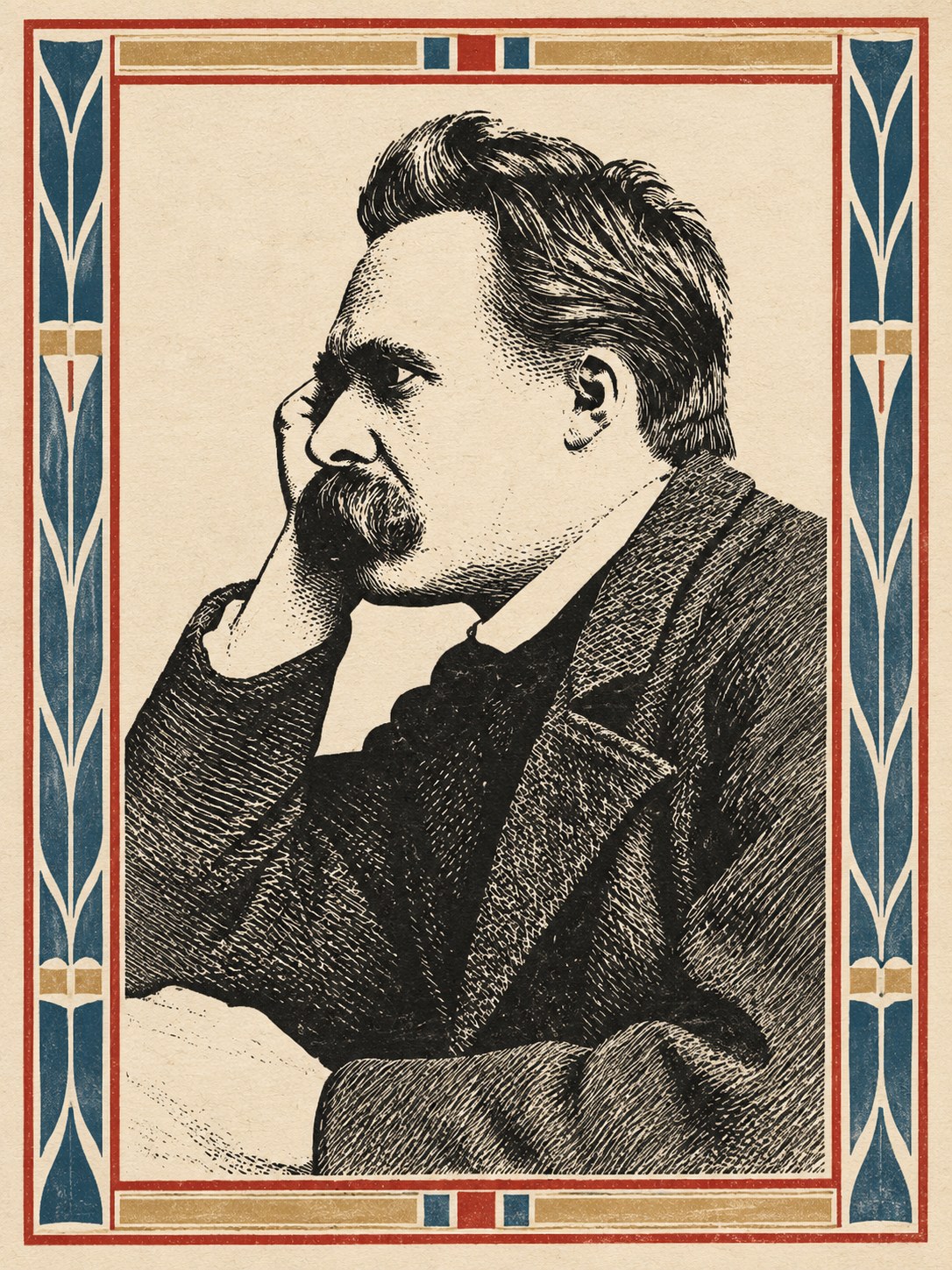
Some are born to enjoy illusions, others are cursed to see the truth.
Not found
No. It is not in Nietzsche’s works, and who first wrote it is not known.
The closest real passage, shown below, is found word for word by program in the German original and in Thomas Common’s English translation (1909); the shared line is not in it.
- Closest passage
- Thus Spoke Zarathustra (1883), Part 2, chapter 8 (“The Famous Wise Ones”, Von den berühmten Weisen)
Researched by AI; closest passage located by program on 31 October 2026. Entry updated 20 October 2026. Editorial review: pending. How we check
Where you would expect it
The closest real passage: Thus Spoke Zarathustra, Part 2, chapter 8 (“The Famous Wise Ones”, Von den berühmten Weisen). The shared line is not in it.
Ah! for me to learn to believe in your “conscientiousness,” ye would first have to break your venerating will.
Ach, dass ich an eure „Wahrhaftigkeit“ glauben lerne, dazu müsstet ihr mir erst euren verehrenden Willen zerbrechen.
Conscientious—so call I him who goeth into God-forsaken wildernesses, and hath broken his venerating heart.
Wahrhaftig—so heisse ich Den, der in götterlose Wüsten geht und sein verehrendes Herz zerbrochen hat.
In the yellow sands and burnt by the sun, he doubtless peereth thirstily at the isles rich in fountains, where life reposeth under shady trees.
Im gelben Sande und verbrannt von der Sonne schielt er wohl durstig nach den quellenreichen Eilanden, wo Lebendiges unter dunkeln Bäumen ruht.
But his thirst doth not persuade him to become like those comfortable ones: for where there are oases, there are also idols.1
Aber sein Durst überredet ihn nicht, diesen Behaglichen gleich zu werden: denn wo Oasen sind, da sind auch Götzenbilder.
Hungry, fierce, lonesome, God-forsaken: so doth the lion-will wish itself.
Hungernd, gewaltthätig, einsam, gottlos: so will sich selber der Löwen-Wille.
Free from the happiness of slaves, redeemed from Deities and adorations, fearless and fear-inspiring, grand and lonesome: so is the will of the conscientious.
Frei von dem Glück der Knechte, erlöst von Göttern und Anbetungen, furchtlos und fürchterlich, gross und einsam: so ist der Wille des Wahrhaftigen.
A gap the length of the shared sentence, which is not in the text.2
Where it comes from
No such sentence occurs in Thus Spoke Zarathustra, the one Nietzsche text in the source texts, in German or in Thomas Common’s English: both were searched for the wording and for illusion, Illusion, Täuschung and Wahn, which occur only in other senses. Wikiquote’s Nietzsche page (checked 20 October 2026) does not list it; its only entry on illusions is a different line, ‘Most people are not seeking truth; they are searching for comfort in illusions’, under Misattributed. Web searches for the full sentence and for each half (‘born to enjoy illusions’, ‘cursed to see the truth’) found no book, article or quotation collection with it. The earliest dated use found is by the self-improvement creator Jett Franzen (@jettfranzen), who posted it on 10 August 2026 as a YouTube Short (description ‘Quote by Nietzsche’) and as a Substack note credited to Friedrich Nietzsche. No earlier source and no author were found. It passes for Nietzsche because the theme is his: from The Birth of Tragedy on he asks whether life needs illusion and whether truth can be borne.
In context
A one-line saying about truth and comfort that circulates on social media under Nietzsche’s name; the passage shown is the closest real one in Thus Spoke Zarathustra. Zarathustra tells the ‘famous wise ones’ that they have served the people and the people’s superstition, not the truth, and were honoured for it. Against them he sets the truthful man (wahrhaftig; Common translates ‘conscientious’), who goes into the desert, looks thirstily at the oases and will not settle there, because where there are oases there are idols.
What it says
The saying: comfort in illusion is a gift, clear sight a burden that only some must bear. Zarathustra’s thought is a demand rather than a lament: truthfulness means choosing the desert over the comfortable oasis and its idols, hungry and alone.
Often misread
Shared as a consolation for the lonely clear-sighted few, cursed by fate to see what others cannot. In Zarathustra seeing the truth is not a curse one is born with but a will one takes on, and the point is to break one’s own need to revere, not to pity oneself for seeing more than the crowd.
Use with care
Not found in Nietzsche. If you want his own thought, use Zarathustra’s truthful man in the desert, who will not settle at the oasis ‘for where there are oases, there are also idols’.
Use this instead
“Conscientious—so call I him who goeth into God-forsaken wildernesses, and hath broken his venerating heart. In the yellow sands and burnt by the sun, he doubtless peereth thirstily at the isles rich in fountains, where life reposeth under shady trees. But his thirst doth not persuade him to become like those comfortable ones: for where there are oases, there are also idols.”
Zarathustra. Thus Spoke Zarathustra (1883), Part 2, chapter 8 (“The Famous Wise Ones”, Von den berühmten Weisen).
Also shared as
- The form on posters and social mediaSome are born to enjoy illusions, Others are cursed to see the truth Title of a YouTube Short by the self-improvement creator Jett Franzen (@jettfranzen), 10 August 2026, with the description ‘Quote by Nietzsche’. Where it was seen
- The form on posters and social mediaSome are born to enjoy illusions, others are cursed to see the truth Substack note by Jett Franzen (@jettfranzen), 10 August 2026, credited to Friedrich Nietzsche. Where it was seen
Topics
Related quotes
- Much unhappiness has come into the world because of bewilderment and things left unsaid. (not found) Fyodor Dostoevsky
- And those who were seen dancing were thought to be insane by those who could not hear the music. (not found)
- The price of loving someone very much is never loving anyone again. (not found) Fyodor Dostoevsky
- The language of friendship is not words but meanings. Henry David Thoreau
- Until you make the unconscious conscious, it will direct your life and you will call it fate. (paraphrase) Carl Gustav Jung
Sources
- en.wikiquote.org/wiki/Friedrich_Nietzsche (not listed; checked 20 October 2026)
- youtube.com/watch?v=EeJdn-Tk_pM (Jett Franzen, 10 August 2026, ‘Quote by Nietzsche’, no source)
- substack.com/@jettfranzen/note/c-311799923 (Jett Franzen, 10 August 2026, credited to Nietzsche, no source)
Cite it
“Some are born to enjoy illusions, others are cursed to see the truth.” Attributed to Friedrich Nietzsche. No. It is not in Nietzsche’s works, and who first wrote it is not known. Quotogeny, https://quotogeny.com/q/some-are-born-to-enjoy-illusions/ (checked 20 October 2026).
Have a different wording, or a source we missed? Check it or submit it.
Do you hold the rights to anything on this page? Tell us.
Checked by people
People who checked this entry against its source, under their own names. Their checks do not change the verdict: an editor reviews every entry.
Comments