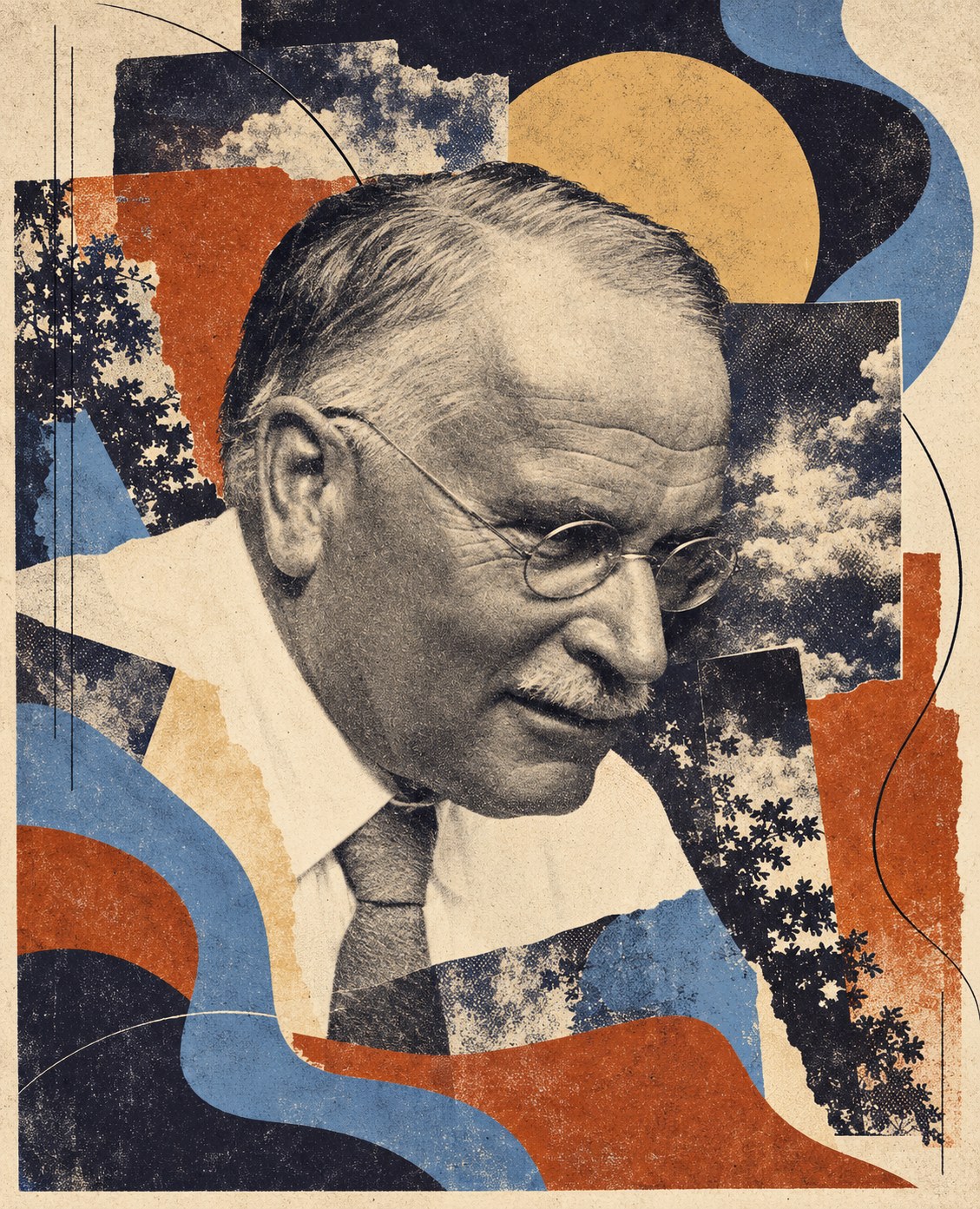
Until you make the unconscious conscious, it will direct your life and you will call it fate.
Paraphrase
Not in these words. The idea is in C. G. Jung, Aion: Researches into the Phenomenology of the Self, trans. R. F. C. Hull, Collected Works vol. 9 part II (Bollingen Series XX; New York: Pantheon / Bollingen Foundation, 1959), ch. V ‘Christ, a Symbol of the Self’. German original: Aion: Untersuchungen zur Symbolgeschichte (Psychologische Abhandlungen VIII, Zürich: Rascher, 1951). Hull’s translation is in copyright; only the one sentence is quoted here, p. 70.
Checked against C. G. Jung, Aion: Researches into the Phenomenology of the Self, trans. R. F. C. Hull, Collected Works vol. 9 part II (Bollingen Series XX; New York: Pantheon / Bollingen Foundation, 1959), ch. V ‘Christ, a Symbol of the Self’. German original: Aion: Untersuchungen zur Symbolgeschichte (Psychologische Abhandlungen VIII, Zürich: Rascher, 1951). Hull’s translation is in copyright; only the one sentence is quoted here, p. 70, in the text of a page scan, not the image.
- The real passage
- Aion, ch. V ‘Christ, a Symbol of the Self’, § 126 (Collected Works 9 part II, p. 70 in the Bollingen edition of 1959)
- Source
- C. G. Jung, Aion: Researches into the Phenomenology of the Self, trans. R. F. C. Hull, Collected Works vol. 9 part II (Bollingen Series XX; New York: Pantheon / Bollingen Foundation, 1959), ch. V ‘Christ, a Symbol of the Self’. German original: Aion: Untersuchungen zur Symbolgeschichte (Psychologische Abhandlungen VIII, Zürich: Rascher, 1951). Hull’s translation is in copyright; only the one sentence is quoted here, p. 70
- Checked
- In the text of a page scan, not the image
Researched by AI. Entry updated 25 October 2026. Editorial review: pending. How we check
About this quote
How the shared form came about
The popular wording is not in Jung’s writings as such: the Aion text of 1959 (CW 9 II, § 126, p. 70) has ‘when an inner situation is not made conscious, it happens outside, as fate’ (Wikiquote’s Talk page for Carl Jung also records it as ‘appears outside as fate’), and goes on about the world acting out the conflict. ‘Until you make the unconscious conscious, it will direct your life and you will call it fate’ is a rewording of that sentence. I searched the full text of CW 9 II (the OCR on archive.org) for ‘fate’ and for the popular words; the popular sentence is not there. I found no earliest dated use of the popular wording: web searches turned up only quote sites (Goodreads, AZQuotes, QuoteFancy, Quozio) that give no source. The German of Aion, which is Jung’s own text (Rascher, 1951), was not seen, so whether Hull’s wording follows it closely is not checked.
In context
At the end of the chapter on Christ as a symbol of the Self Jung discusses how Christian psychology sharpened the opposites of good and evil, and hopes the present world situation, a humanity split into two apparently irreconcilable halves, may be looked at ‘in the light of the psychological rule’. The rule is the sentence quoted. He then spells it out: when the individual remains undivided and does not become conscious of his inner contradictions, the world must perforce act out the conflict and be torn into opposite halves.
What it says
What is not faced inside is met outside, as something that seems to be done to us. Jung’s concern in the passage is the split of the whole world in the Cold War, as a projection of an unresolved conflict in the individual; it is not advice on running a personal life.
Often misread
The popular form turns a diagnosis of a divided world into a promise of self-help: make the unconscious conscious and you will stop being ruled by fate. It also puts ‘direct your life’ and ‘call it fate’ in Jung’s mouth, which are not in the passage.
Also shared as
- ShortenedUntil you make the unconscious conscious, it will direct your life and you will call it fate. The wording on Goodreads, AZQuotes and QuoteFancy, credited to Jung without a source. Where it was seen
Topics
Related quotes
- If you want to know what a man’s like, take a good look at how he treats his inferiors, not his equals. J. K. Rowling
- The universe is change; our life is what our thoughts make it. (paraphrase) Marcus Aurelius
- We accept the love we think we deserve. Stephen Chbosky
- It does not do to dwell on dreams and forget to live, remember that. J. K. Rowling
- The privilege of a lifetime is to become who you truly are. (not found)
Sources
Cite it
“Until you make the unconscious conscious, it will direct your life and you will call it fate.” Attributed to Carl Gustav Jung. Not in these words. The idea is in C. G. Jung, Aion: Researches into the Phenomenology of the Self, trans. R. F. C. Hull, Collected Works vol. 9 part II (Bollingen Series XX; New York: Pantheon / Bollingen Foundation, 1959), ch. V ‘Christ, a Symbol of the Self’. German original: Aion: Untersuchungen zur Symbolgeschichte (Psychologische Abhandlungen VIII, Zürich: Rascher, 1951). Hull’s translation is in copyright; only the one sentence is quoted here, p. 70. Quotogeny, https://quotogeny.com/q/unconscious-conscious-fate/ (checked 25 October 2026).
Have a different wording, or a source we missed? Check it or submit it.
Do you hold the rights to anything on this page? Tell us.
Checked by people
People who checked this entry against its source, under their own names. Their checks do not change the verdict: an editor reviews every entry.
Comments