The course of life is fixed, and nature admits of its being run but in one way, and only once.
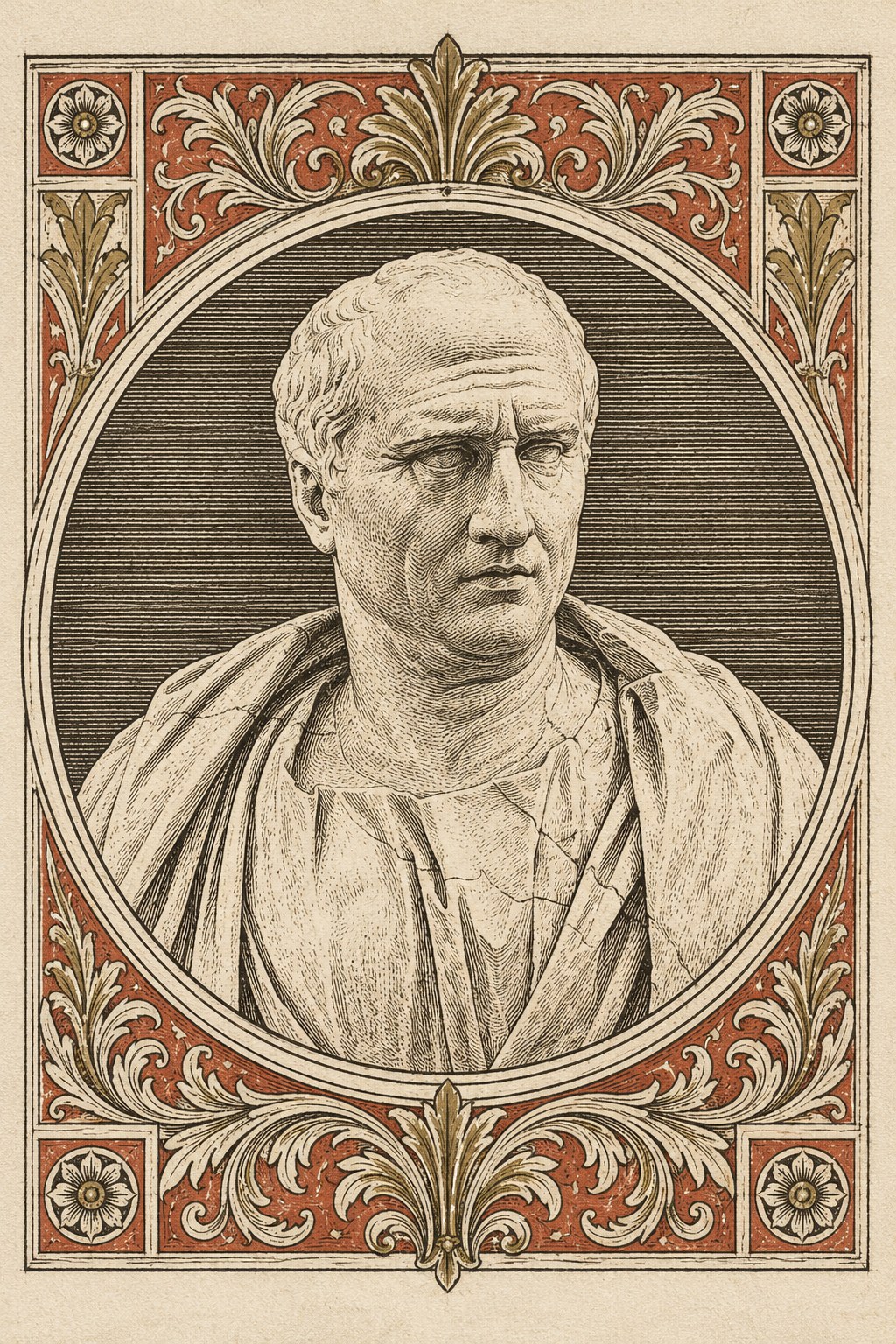
Genuine
Yes. In On Old Age (44 BC), Chapter X, section 33 (Cato Maior de Senectute 10.33), said by Marcus Porcius Cato the Elder. These are the character’s words, not a statement in Cicero’s own voice.
Found word for word by program in the Latin original and in E. S. Shuckburgh’s English translation.
The wording people share comes from a later translation; Shuckburgh’s words are underlined below.
- Work
- On Old Age (Cato Maior de Senectute), 44 BC
- Where
- Chapter X, section 33 (Cato Maior de Senectute 10.33)
- Found at
- Paragraph 62 of the Latin text, 46 of the English
- Translation
- E. S. Shuckburgh
Researched by AI; checked by program against the full text on 29 November 2026. Editorial review: pending. How we check
On the page
Old when young Is old for long.
[…] Ego vero me minus diu senem esse mallem quam esse senem, ante quam essem. Itaque nemo adhuc convenire me voluit, cui fuerim occupatus.
[…] Which then of the two would you prefer to have given to you—bodily strength like that, or intellectual strength like that of Pythagoras? In fine, enjoy that blessing when you have it; when it is gone, don’t wish it back—unless we are to think that young men should wish their childhood back, and those somewhat older their youth! The course of life is fixed, and nature admits of its being run but in one way, and only once; and to each part of our life there is something specially seasonable; so that the feebleness of children, as well as the high spirit of youth, the soberness of maturer years, and the ripe wisdom of old age—all have a certain natural advantage which should be secured in its proper season.12 I think you are informed, Scipio, what your grandfather’s foreign friend Masinissa does to this day, though ninety years old. When he has once begun a journey on foot he does not mount his horse at all; when on horseback he never gets off his horse. […]
[…] Olympiae per stadium ingressus esse Milo dicitur, cum umeris sustineret bovem. Utrum igitur has corporis an Pythagorae tibi malis vires ingeni dari? Denique isto bono utare, dum adsit, cum absit, ne requiras, nisi forte adulescentes pueritiam, paululum aetate progressi adulescentiam debent requirere. Cursus est certus aetatis et una via naturae, eaque simplex, suaque cuique parti aetatis tempestivitas est data, ut et infirmitas puerorum, et ferocitas iuvenum et gravitas iam constantis aetatis et senectutis maturitas naturale quiddam habeat, quod suo tempore percipi debeat.
11. Bodily strength is wanting to old age; but neither is bodily strength demanded from old men. […]
34. […]
12. The third charge against old age is that it LACKS SENSUAL PLEASURES. What a splendid service does old age render, if it takes from us the greatest blot of youth! […]
35. At multi ita sunt imbecilli senes, ut nullum offici aut omnino vitae munus exsequi possint. At id quidem non proprium senectutis vitium est, sed commune valetudinis. Quam fuit imbecillus P. […]
The scene
Cato is answering the objection that old age loses bodily strength. He contrasts Milo’s physical strength with Pythagoras’ intellectual strength, then says not to wish back an earlier stage of life. Each age has its own appropriate capacities; he goes on to praise the elderly Masinissa’s active habits.
What it means
Life cannot be rerun, and each stage has strengths to use rather than merely losses to regret.
Often misread
The fixed course is the succession of life’s ages, not a claim that every event is predestined. Cato’s next example stresses exercise and temperance, not passive resignation.
Topics
Related quotes
- Old age, to which all wish to attain, and at which all grumble when attained.
- There is nothing stronger than those two: patience and time. Leo Tolstoy
- Again, all things that accord with nature are to be counted as good.
- Is not the world the common homeland of all human beings, as Socrates maintained? Musonius Rufus
- The means may be likened to a seed, the end to a tree; and there is just the same inviolable connection between the means and the end as there is between the seed and the tree. Mahatma Gandhi
Sources
Cite it
Marcus Tullius Cicero, On Old Age (44 BC), Chapter X, section 33 (Cato Maior de Senectute 10.33), translated by E. S. Shuckburgh. Spoken by Marcus Porcius Cato the Elder. Checked at Quotogeny, https://quotogeny.com/q/the-course-of-life-is-fixed/ (29 November 2026).
Have a different wording, or a source we missed? Check it or submit it.
Do you hold the rights to anything on this page? Tell us.
Checked by people
People who checked this entry against its source, under their own names. Their checks do not change the verdict: an editor reviews every entry.
Comments