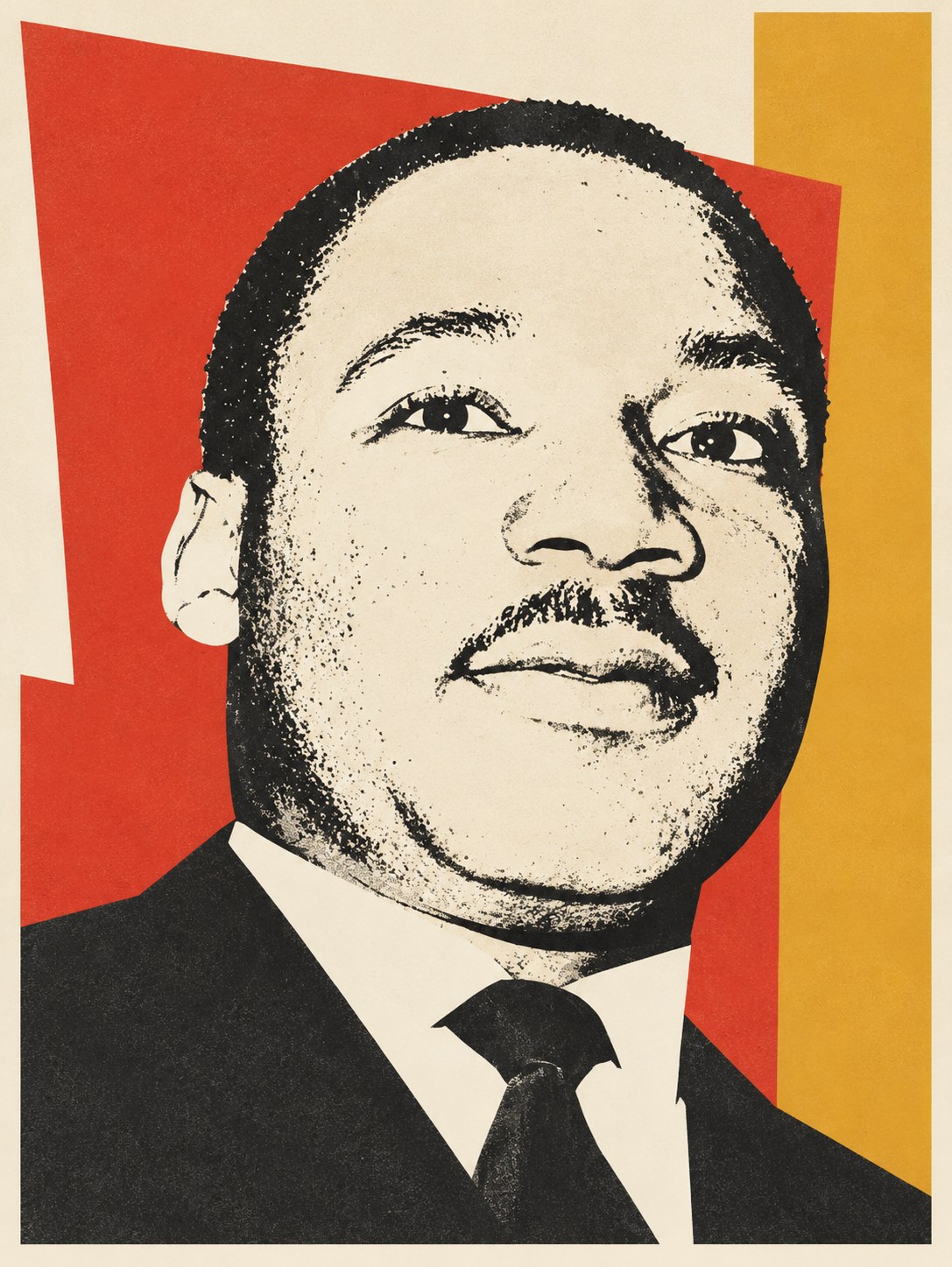
I have a dream that my four little children will one day live in a nation where they will not be judged by the color of their skin but by the content of their character.
Genuine
Yes. In I Have a Dream (1963), March on Washington for Jobs and Freedom, 28 August 1963; “I have a dream” sequence, after the Mississippi passage.
Checked against Martin Luther King, Jr., I Have a Dream, March on Washington for Jobs and Freedom, Washington, D.C., 28 August 1963; transcription published by Virginia Commonwealth University Libraries, Social Welfare History Project, in a full-text transcription.
- Work
- I Have a Dream, 1963
- Where
- March on Washington for Jobs and Freedom, 28 August 1963; “I have a dream” sequence, after the Mississippi passage
- Source
- Martin Luther King, Jr., I Have a Dream, March on Washington for Jobs and Freedom, Washington, D.C., 28 August 1963; transcription published by Virginia Commonwealth University Libraries, Social Welfare History Project
- Checked
- In a full-text transcription
Researched by AI. Entry updated 24 October 2026. Editorial review: pending. How we check
About this quote
The scene
Speaking at the March on Washington, King describes ongoing segregation, poverty, police brutality and denial of voting rights before turning to the dream of a transformed nation. In the sequence of imagined changes, he moves from Mississippi to the future of his own four children, then to Black and white children joining hands in Alabama.
What it means
He imagines a country where his children’s worth is not determined by their race and where racial exclusion has been overcome.
Often misread
Extracting this sentence as a prohibition on acknowledging race erases the speech’s explicit account of racial injustice and its demand for concrete civil rights changes. It is a vision of freedom from racial discrimination, not a claim that existing inequalities can be ignored.
Topics
Related quotes
- We know through painful experience that freedom is never voluntarily given by the oppressor; it must be demanded by the oppressed.
- Let no one be slow to seek wisdom when he is young nor weary in the search thereof when he is grown old. For no age is too early or too late for the health of the soul. Epicurus
- By definition, he cannot today put himself at the service of those who make history: he serves those who undergo it. Albert Camus
- Darkness cannot drive out darkness: only light can do that. Hate cannot drive out hate: only love can do that.
- I am not what happened to me. I am what I choose to become. (misattributed) Carl Gustav Jung
Cite it
Martin Luther King Jr., I Have a Dream (1963), March on Washington for Jobs and Freedom, 28 August 1963; “I have a dream” sequence, after the Mississippi passage. Checked at Quotogeny, https://quotogeny.com/q/content-of-their-character/ (24 October 2026).
Have a different wording, or a source we missed? Check it or submit it.
Do you hold the rights to anything on this page? Tell us.
Checked by people
People who checked this entry against its source, under their own names. Their checks do not change the verdict: an editor reviews every entry.
Comments