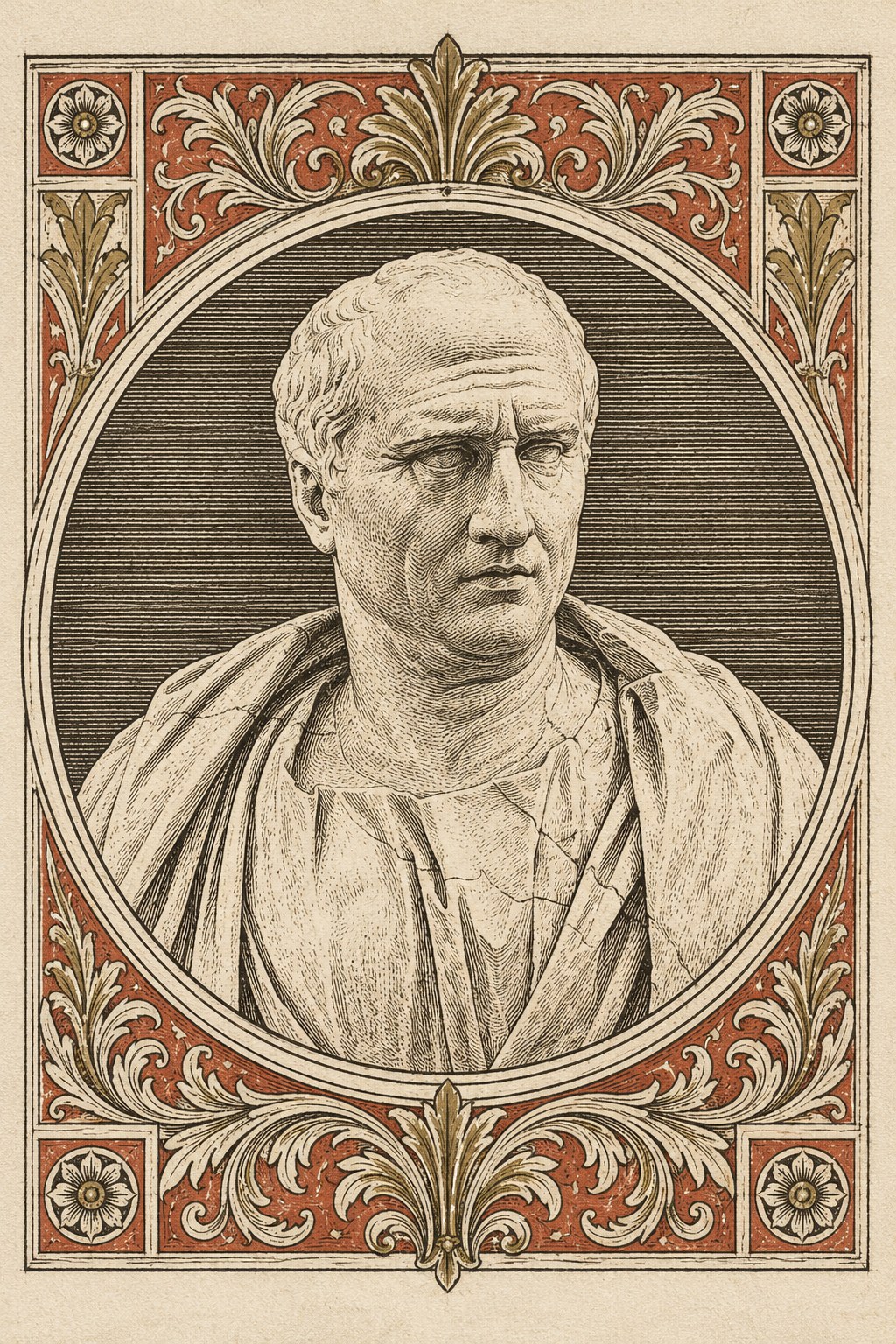
If you have a garden and a library, you have everything you need.
Paraphrase
Not in these words. The idea is in a letter to Marcus Terentius Varro, Book IX, letter 4 (Fam. IX.4), from Tusculum, June 46 BC.
The real passage, shown below, is found word for word by program in the Latin original and in E. S. Shuckburgh’s English translation (1900).
Checked against Cicero, letter to M. Terentius Varro, Ad Familiares IX.4, from Tusculum, June 46 BC. English: Evelyn S. Shuckburgh, The Letters of Cicero: the whole extant correspondence in chronological order, vol. 3 (London: George Bell and Sons, 1900), letter CCCCLXIV (F IX, 4), pp. 82–83. Latin: L. C. Purser’s Oxford text, Epistulae ad Familiares IX.4, as digitised by the Perseus Digital Library, Shuckburgh vol. 3, pp. 82–83, in the text of a page scan, not the image.
- Work
- Letters to Friends (Epistulae ad Familiares)
- The real passage
- Letter to Marcus Terentius Varro, Book IX, letter 4 (Fam. IX.4), from Tusculum, June 46 BC
- Source
- Cicero, letter to M. Terentius Varro, Ad Familiares IX.4, from Tusculum, June 46 BC. English: Evelyn S. Shuckburgh, The Letters of Cicero: the whole extant correspondence in chronological order, vol. 3 (London: George Bell and Sons, 1900), letter CCCCLXIV (F IX, 4), pp. 82–83. Latin: L. C. Purser’s Oxford text, Epistulae ad Familiares IX.4, as digitised by the Perseus Digital Library, Shuckburgh vol. 3, pp. 82–83
- Checked
- In the text of a page scan, not the image
Researched by AI; closest passage located by program on 31 October 2026. Entry updated 23 October 2026. Editorial review: pending. How we check
The real passage
CDLXIV (F IX, 4) TO M. TERENTIUS VARRO (?AT CUMAE) TUSCULUM (JUNE)
Scr. in Tusculano inter viii et iv Id. Iun. a. 708 (46). CICERO VARRONI
[…] Now see which opinion pleases you the more, that of Chrysippus or the one which our teacher Diodotus could not stomach. But on these points also we will talk when we are at leisure: that too is “possible,” according to Chrysippus. I am much obliged to you about Coctius: for that is just what I had commissioned Atticus to do. Yes, if you don’t come to me, I shall take a run to you. If you have a garden in your library, everything will be complete.1
Περὶ δυνατῶν me scito κατὰ Διόδωρον κρίνειν. quapropter si venturus es, scito necesse esse te venire; sin autem non es, ἀδυνάτων est te venire. nunc vide utra te κρίσις magis delectet, Chrysippi an haec, quam noster Diodotus non concoquebat. sed de his etiam rebus, otiosi cum erimus, loquemur; hoc etiam κατὰ Χρύσιππον δυνατὸν? est. de Coctio mihi gratum est; nam id etiam Attico mandaram. tu si minus ad nos, nos accurremus ad te; si hortum in bybliotheca habes, deerit nihil.
Cicero playfully alludes to the necessitudinarian doctrines of Diodorus of Caria (the Megaric philosopher, ob. B.C. 307) and Chrysippus of Soli, the Stoic (born B.C. 280). […]
Probably means (though it is a strange way of expressing it) a garden to sit and converse in, like philosophers in the Academy: the library being like Cicero’s Tusculan gymnasium, round a court containing shrubs, etc. […]
How the shared form came about
The popular form changes Cicero’s ‘a garden in your library’ (‘hortum in bybliotheca’, or ‘in bibliotheca’ in other editions) to ‘a garden and a library’ and his ‘nothing will be lacking’ to ‘you have everything you need’. Wikiquote gives exactly this English under Ad Familiares IX.4, and Goodreads ranks it second among Cicero quotes (6,614 likes on 23 October 2026). When the reworded form was first printed was not established in this run.
In context
June 46 BC: Caesar has won at Thapsus and Cicero, out of public life, is at his villa at Tusculum, writing and seeing friends. This is a short, joking note to Varro, the most learned Roman of the day, about whether Varro will come to visit: Cicero plays with the Greek logicians’ arguments about what is ‘possible’ and ‘necessary’, thanks him for a favour, and says that if Varro does not come, he will hurry over to him. The last sentence is the one now quoted.
What it says
A friend’s promise of a pleasant stay: if Varro’s library has a garden to it, a place to sit and talk among the books, they will want for nothing. Shuckburgh notes that it probably means a garden to sit and converse in, like philosophers in the Academy.
Often misread
Quoted as Cicero’s recipe for a contented life, two things that are all one needs. The letter speaks of a garden in, or attached to, one particular library, Varro’s, as the setting for a visit and a conversation between friends; ‘and’ turns it into a general rule, and ‘everything you need’ adds the moral.
Also shared as
- ShortenedIf you have a garden and a library, you have everything you need. The popular form, on Goodreads credited to ‘Cicero’, 6,614 likes on 23 October 2026. Where it was seen
- ShortenedSi hortum in bibliotheca habes, deerit nihil. The clause alone, as Wikiquote prints it (with the common spelling ‘bibliotheca’), cut from Cicero’s sentence about coming to visit. Where it was seen
Related quotes
- A room without books is like a body without a soul. (paraphrase)
- Friendship is born at the moment when one man says to another “What! You too? I thought that no one but myself...” C. S. Lewis
- Heaven is under our feet as well as over our heads. Henry David Thoreau
- And in that moment, I swear we were infinite. Stephen Chbosky
- no one would choose to live without friends. Aristotle
Sources
- archive.org/details/letterscicerowh04shucgoog (Shuckburgh, The Letters of Cicero, vol. 3, 1900, pp. 82–83)
- raw.githubusercontent.com/PerseusDL/canonical-latinLit/master/data/phi0474/phi056/phi0474.phi056.perseus-lat2.xml (Purser’s Latin, Fam. 9.4)
- raw.githubusercontent.com/PerseusDL/canonical-latinLit/master/data/phi0474/phi056/phi0474.phi056.perseus-eng1.xml (Shuckburgh’s English, letter CDLXIV)
- en.wikiquote.org/wiki/Cicero (Epistulae ad Familiares: ‘If you have a garden and a library…’, To Varro, IX, 4)
Cite it
“If you have a garden and a library, you have everything you need.” Attributed to Marcus Tullius Cicero. Not in these words. The idea is in a letter to Marcus Terentius Varro, Book IX, letter 4 (Fam. IX.4), from Tusculum, June 46 BC. Quotogeny, https://quotogeny.com/q/if-you-have-a-garden-and-a-library/ (checked 23 October 2026).
Have a different wording, or a source we missed? Check it or submit it.
Do you hold the rights to anything on this page? Tell us.
Checked by people
People who checked this entry against its source, under their own names. Their checks do not change the verdict: an editor reviews every entry.
Comments