We are not born for ourselves alone.
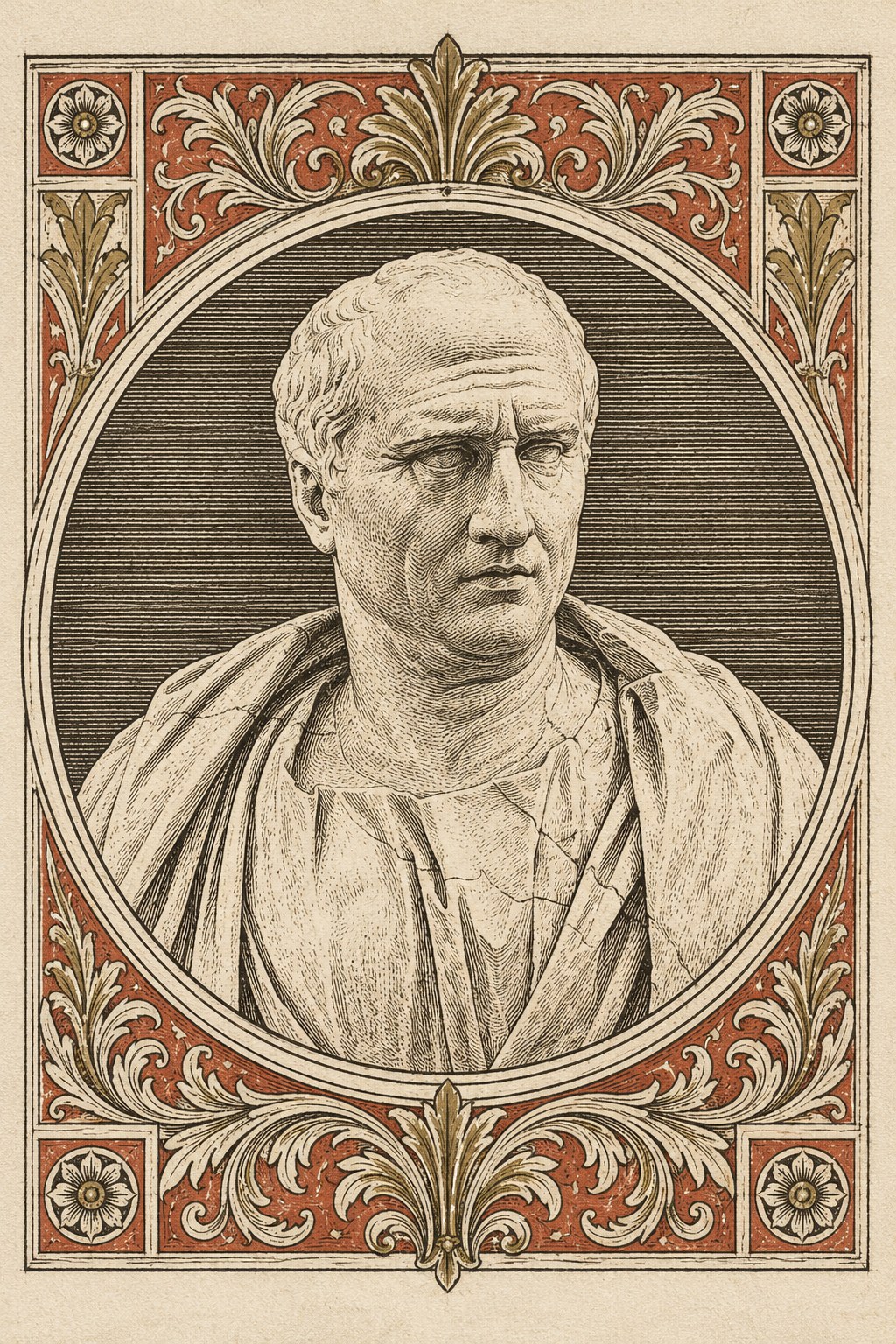
Genuine
Yes. In On Duties (44 BC), Book I, chapter VII, section 22 (I.7.22).
Found word for word by program in the Latin original and in Walter Miller’s English translation (1913).
The wording people share comes from a later translation; Miller’s words are underlined below.
- Work
- On Duties (De Officiis), 44 BC
- Where
- Book I, chapter VII, section 22 (I.7.22)
- Found at
- Paragraph 23 of the Latin text, 6 of the English
- Translation
- Walter Miller, 1913
Researched by AI; checked by program against the full text on 31 October 2026. Editorial review: pending. How we check
On the page
[…] Therefore, inasmuch as in each case some of those things which by nature had been common property became the property of individuals, each one should retain possession of that which has fallen to his lot; and if anyone appropriates to himself anything beyond that, he will be violating the laws of human society.
[…] Ex quo, quia suum cuiusque fit eorum, quae natura fuerant communia, quod cuique optigit, id quisque teneat; e quo si quis [quaevis] sibi appetet, violabit ius humanae societatis.
22 But since, as Plato has admirably expressed it, we are not born for ourselves alone, but our country claims a share of our being, and our friends a share;1 and since, as the Stoics hold, everything that the earth produces is created for man’s use; and as men, too, are born for the sake of men, that they may be able mutually to help one another; in this direction we ought to follow Nature as our guide, to contribute to the general good by an interchange of acts of kindness, by giving and receiving, and thus by [25] our skill, our industry, and our talents to cement human society more closely together, man to man.
[22] Sed quoniam, ut praeclare scriptum est a Platone, non nobis solum nati sumus ortusque nostri partem patria vindicat, partem amici, atque, ut placet Stoicis, quae in terris gignantur, ad usum hominum omnia creari, homines autem hominum causa esse generatos, ut ipsi inter se aliis alii prodesse possent, in hoc naturam debemus ducem sequi, communes utilitates in medium adferre, mutatione officiorum, dando accipiendo, tum artibus, tum opera, tum facultatibus devincire hominum inter homines societatem.
Good faith.
[23] Fundamentum autem est iustitiae fides, id est dictorum conventorumque constantia et veritas. […]
23 The foundation of justice, moreover, is good faith—that is, truth and fidelity to promises and agreements. […]
[24] Atque illae quidem iniuriae, quae nocendi causa de industria inferuntur, saepe a metu proficiscuntur, cum is, qui nocere alteri cogitat, timet, ne, nisi id fecerit, ipse aliquo afficiatur incommodo. […]
The scene
In a treatise addressed to his son Marcus, Cicero is explaining the duties that maintain human society. After distinguishing common possessions from private property, he credits Plato with the thought that our country and friends have claims upon us. He connects this with the Stoic view that human beings exist to help one another, and urges exchanges of kindness, work and resources that bind society together.
What it means
Our lives carry obligations to other people, not just to our own advantage. Cicero uses the thought to ground practical cooperation and mutual service.
Often misread
Often detached as Cicero’s original motto. In the sentence itself he explicitly credits Plato; it is Cicero’s endorsement and Latin formulation of a thought he presents as inherited, not a claim to have invented it.
Topics
Related quotes
- More law, less justice.
- That which is not good for the swarm, neither is it good for the bee. (paraphrase) Marcus Aurelius
- The universe is change; our life is what our thoughts make it. (paraphrase) Marcus Aurelius
- Love is the only force capable of transforming an enemy into a friend. Martin Luther King Jr.
- If it is not right, do not do it: if it is not true, do not say it. Marcus Aurelius
Sources
- thelatinlibrary.com/cicero/off1.shtml#22
- gutenberg.org/cache/epub/47001/pg47001-images.html#I.22 (Walter Miller, 1913; Latin and English transcription)
- en.wikiquote.org/wiki/Cicero (On Duties; circulating short form)
Cite it
Marcus Tullius Cicero, On Duties (44 BC), Book I, chapter VII, section 22 (I.7.22), translated by Walter Miller (1913). Checked at Quotogeny, https://quotogeny.com/q/we-are-not-born-for-ourselves-alone/ (31 October 2026).
Have a different wording, or a source we missed? Check it or submit it.
Do you hold the rights to anything on this page? Tell us.
Checked by people
People who checked this entry against its source, under their own names. Their checks do not change the verdict: an editor reviews every entry.
Comments