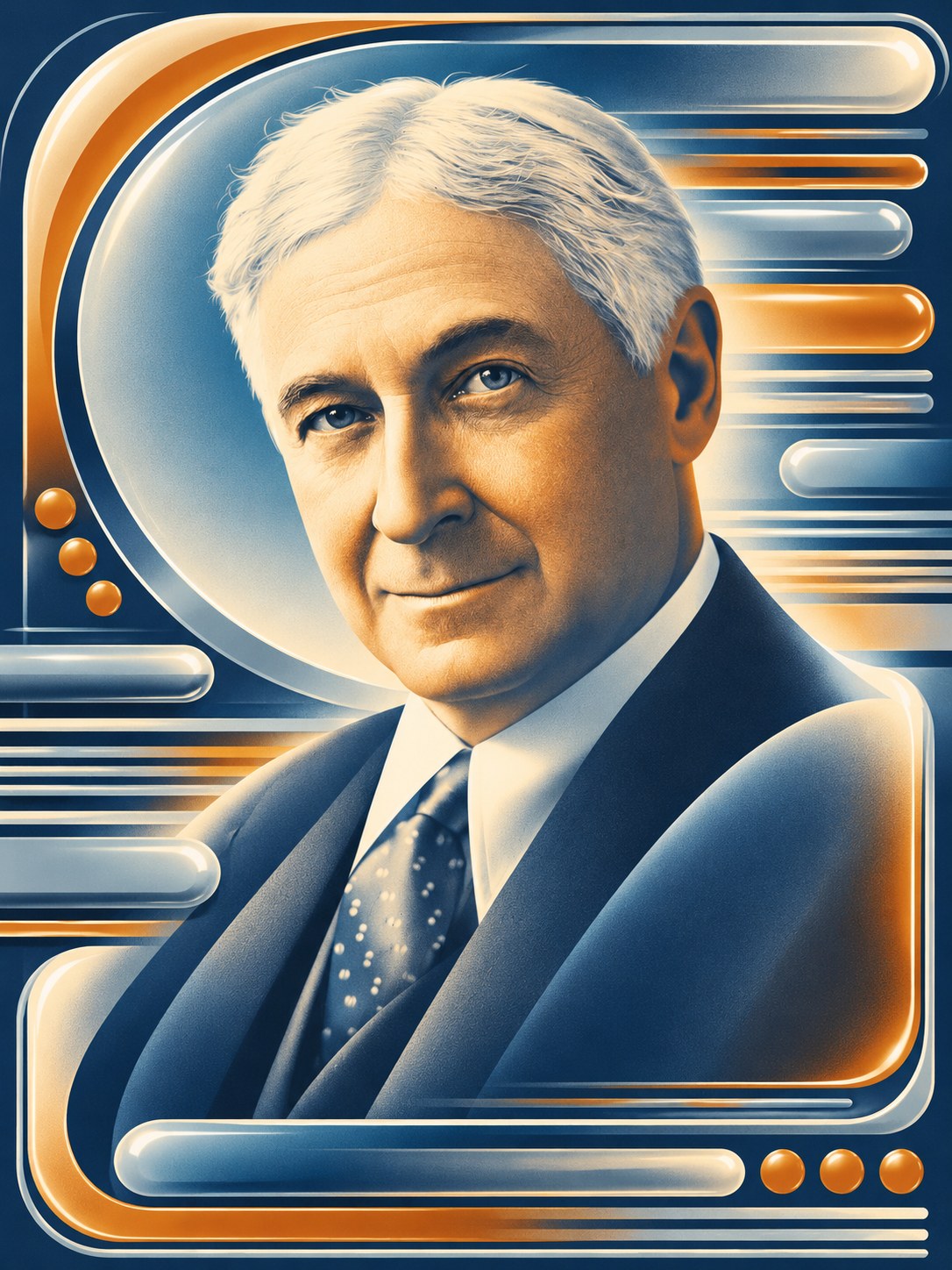
Bernard Baruch
1870–1965. Bernard Mannes Baruch
8 genuine quotes, each found in the text, and 5 wrongly credited to Baruch.
American financier who made a fortune on the New York Stock Exchange, chaired the War Industries Board in the First World War and advised presidents from Wilson to Truman; in 1946 he put the Baruch Plan for international control of atomic energy to the United Nations. Some sayings credited to him are known only from newspaper reports and anecdote collections, not from his own speeches or memoirs.
FrontispieceMade by an image model after Harris & Ewing’s photograph of Bernard M. Baruch (between 1905 and 1945, public domain), in the manner of Streamline Moderne (1930–1945). The likeness is the original’s; this picture is AI‑generated and not historical. The endpaper behind it is an AI‑generated pattern in the same manner.

Genuine Baruch quotes
- Every man has a right to his opinion, but no man has a right to be wrong in his facts.
Associated Press, “Baruch Upholds U.S. Atom Plan; Hits at Wallace”, dateline 8 October 1946, in The Galveston Daily News, 9 October 1946, Remarks reported in an Associated Press article of 8 October 1946, “Baruch Upholds U.S. Atom Plan; Hits at Wallace”.
- We are now facing a problem more of ethics than of physics.
Address to the United Nations Atomic Energy Commission (the Baruch Plan) (1946), Address to the United Nations Atomic Energy Commission, 14 June 1946, immediately before the numbered measures beginning ‘1. General.’.
- All economic movements, by their very nature, are motivated by crowd psychology.
Congressional Record, Senate, 12 March 1948, vol. 94, p. 2628, quotation of Bernard Baruch’s preface to the 1932 L. C. Page & Co. edition of Charles Mackay, Extraordinary Popular Delusions and the Madness of Crowds, Preface to Charles Mackay, Extraordinary Popular Delusions and the Madness of Crowds (1932), passage reprinted in the Congressional Record, 12 March 1948, p. 2628.
- We are here to make a choice between the quick and the dead.
Address to the United Nations Atomic Energy Commission (the Baruch Plan) (1946), Opening of the address to the United Nations Atomic Energy Commission, 14 June 1946.
- Old age is 15 years older than I am.
TIME, ‘Nation: The Man Behind the Legend’, 2 July 1965, final paragraph, Reported in TIME, ‘Nation: The Man Behind the Legend’, 2 July 1965, final paragraph.
- Peace is never long preserved by weight of metal or by an armament race.
Address to the United Nations Atomic Energy Commission (the Baruch Plan) (1946), Address to the United Nations Atomic Energy Commission, 14 June 1946; paragraph after “Let this be anchored in our minds” and before the discussion of ethics and physics.
- We are today in the midst of a cold war.
Bernard Baruch, speech to the South Carolina House of Representatives, Columbia, 16 April 1947; Journal of the House of Representatives of the First Session of the 87th General Assembly of the State of South Carolina, 1947, p. 1085, Speech to the South Carolina House of Representatives, Columbia, 16 April 1947.
- We must elect World Peace or World Destruction.
Address to the United Nations Atomic Energy Commission (the Baruch Plan) (1946), Address to the United Nations Atomic Energy Commission, 14 June 1946; opening paragraph beginning “Behind the black portent of the new atomic age”.
Quotes wrongly credited to Baruch
- Be who you are and say what you feel, because those who mind don’t matter, and those who matter don’t mind.
Misattributed. It is not by Baruch; it was written by an unknown writer.
- Anyone taken as an individual is tolerably sensible—as a member of a crowd, he at once becomes a blockhead.
Misattributed. Baruch quoted it as Schiller’s, not as his own. The German couplet is in Goethe and Schiller’s jointly published Xenien; its individual authorship is not resolved here.
- Buy when there’s blood in the streets.
Not found. No primary source establishes this as Baruch’s saying. The proverb predates its documented 1980 credit to him, and its original speaker remains uncertain.
- If all you have is a hammer, everything looks like a nail.
Not found. The attribution to Baruch is unsubstantiated. Earlier related formulations are documented under Kaplan, Tomkins and Maslow; the later Baruch label does not establish authorship.
- When a shoeshine boy knows as much as I do about the stock market, it’s time to get out.
Not found. Told first of Joseph P. Kennedy Sr. (1959); Baruch’s memoir mentions the shoeshine boy but not as his signal.
The works we hold
Quotes are looked up word for word in these texts. The number is how many genuine quotes here come from each.
| Work | Year | Genuine quotes |
|---|---|---|
| Address to the United Nations Atomic Energy Commission (the Baruch Plan) Address to the United Nations Atomic Energy Commission | 1946 | 4 |