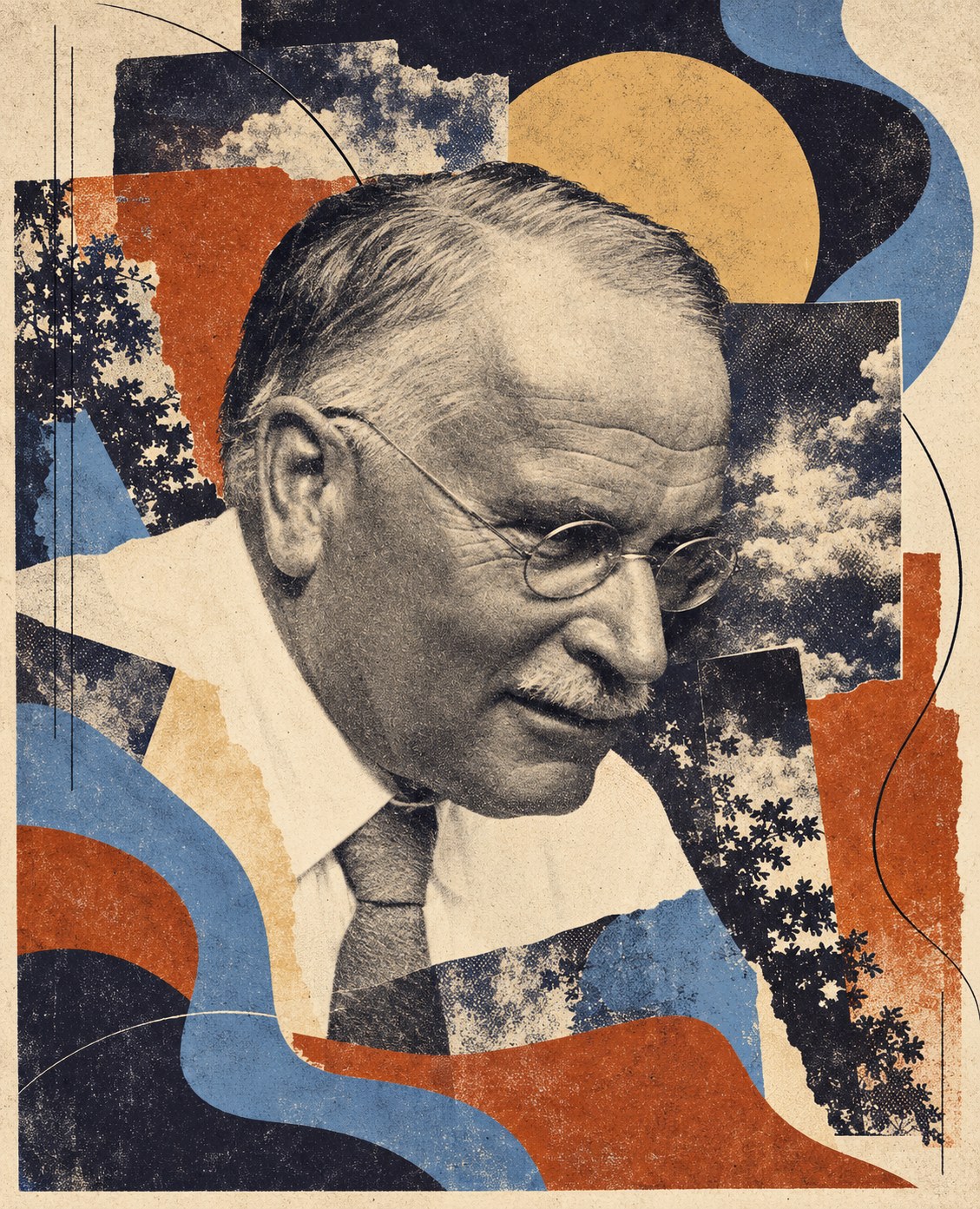
Carl Gustav Jung
1875–1961
2 genuine quotes, each found in the text, and 3 wrongly credited to Jung.
Swiss psychiatrist who worked with Freud and broke with him in 1913 to found analytical psychology: the collective unconscious, archetypes, introversion and extraversion, individuation. He wrote mostly in German but also in English, and many of the lines credited to him online are condensations of longer, carefully hedged passages or not his at all.
FrontispieceMade by an image model after an unknown photographer’s photograph of C. G. Jung (about 1935, public domain), in the manner of Surrealist graphics (1924–1960). The likeness is the original’s; this picture is AI‑generated and not historical. The endpaper behind it is an AI‑generated pattern in the same manner.
Genuine Jung quotes
- I don’t need to believe, I know.
Letters (1959), BBC Face to Face interview with John Freeman, broadcast 22 October 1959; quoted in note 1 to the letter to Valentine Brooke, 16 November 1959, Letters vol. 2, pp. 520–521.
- No scientific statement is final: it is a likely formulation of observation and analysis.
Letters (1959), letter to Valentine Brooke, 16 November 1959, Letters vol. 2, p. 522.
Quotes wrongly credited to Jung
- Called or uncalled, God will be present.
Misattributed. anonymous wrote it, not Jung.
- I am not what happened to me. I am what I choose to become.
Misattributed. James Hollis wrote it, not Jung.
- The privilege of a lifetime is to become who you truly are.
Not found. It is not in Jung’s works, and who first wrote it is not known.
Paraphrased: Jung’s thought, in other words
- All addictions are a low-level search for God.
Paraphrase. The idea is in a letter to William G. Wilson (Bill W.), 30 January 1961.
- Until you make the unconscious conscious, it will direct your life and you will call it fate.
Paraphrase. The idea is in C. G. Jung, Aion: Researches into the Phenomenology of the Self, trans. R. F. C. Hull, Collected Works vol. 9 part II (Bollingen Series XX; New York: Pantheon / Bollingen Foundation, 1959), ch. V ‘Christ, a Symbol of the Self’. German original: Aion: Untersuchungen zur Symbolgeschichte (Psychologische Abhandlungen VIII, Zürich: Rascher, 1951). Hull’s translation is in copyright; only the one sentence is quoted here, p. 70.
The works we hold
Quotes are looked up word for word in these texts. The number is how many genuine quotes here come from each.
| Work | Year | Genuine quotes |
|---|---|---|
| Letters Briefe | 1973 | 2 |