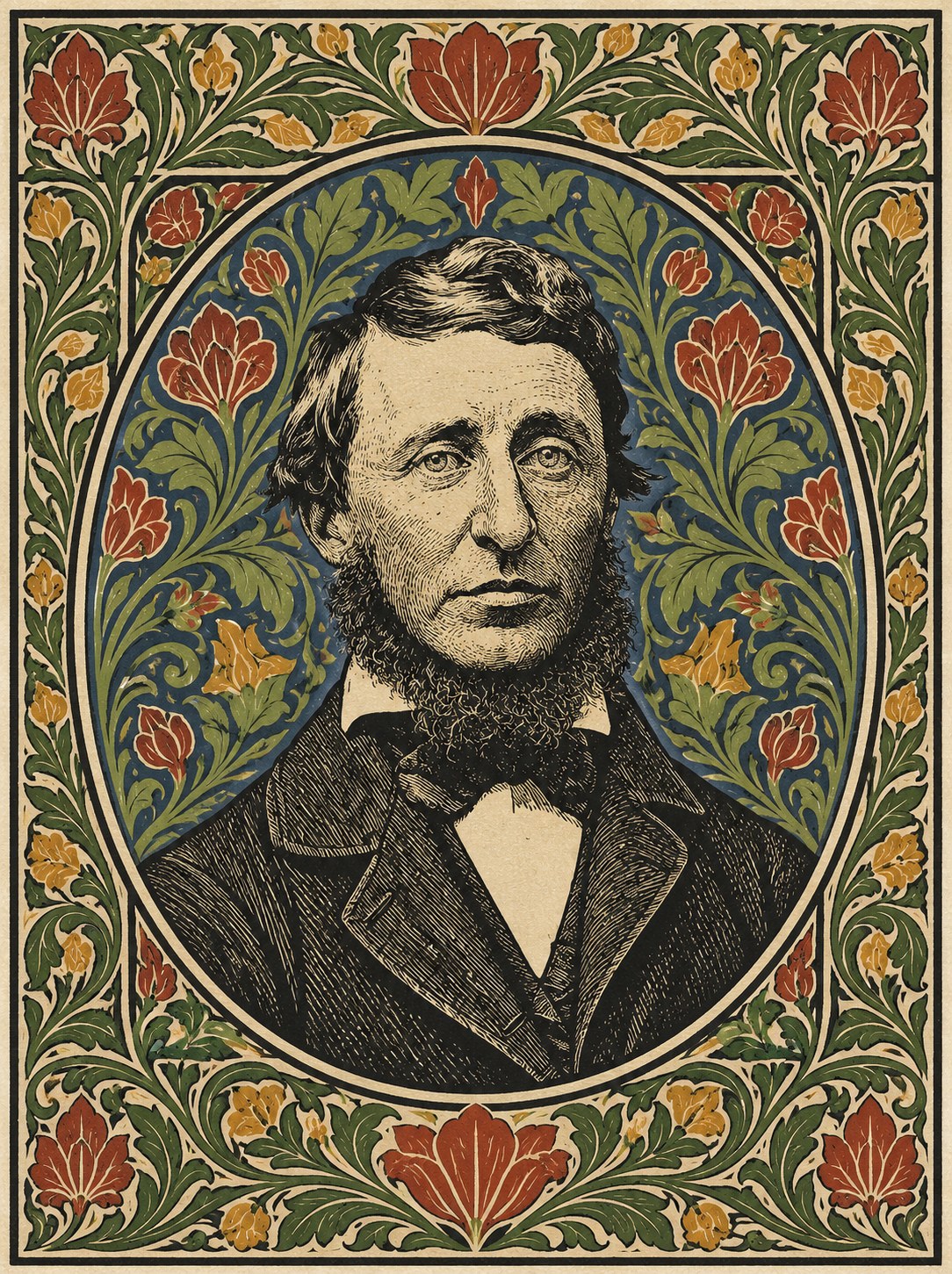
What a man thinks of himself becomes his fate.
Paraphrase
Not in these words. The idea is in Walden (1854), Chapter 1, “Economy”.
The real passage, shown below, is found word for word by program in the full text.
- Work
- Walden (Walden; or, Life in the Woods), 1854
- The real passage
- Chapter 1, “Economy”
Researched by AI; closest passage located by program on 31 October 2026. Entry updated 20 October 2026. Editorial review: pending. How we check
The real passage
[…] It is very evident what mean and sneaking lives many of you live, for my sight has been whetted by experience; always on the limits, trying to get into business and trying to get out of debt, a very ancient slough, called by the Latins æs alienum, another’s brass, for some of their coins were made of brass; still living, and dying, and buried by this other’s brass; always promising to pay, promising to pay, tomorrow, and dying today, insolvent; seeking to curry favor, to get custom, by how many modes, only not state-prison offences; lying, flattering, voting, contracting yourselves into a nutshell of civility or dilating into an atmosphere of thin and vaporous generosity, that you may persuade your neighbor to let you make his shoes, or his hat, or his coat, or his carriage, or import his groceries for him; making yourselves sick, that you may lay up something against a sick day, something to be tucked away in an old chest, or in a stocking behind the plastering, or, more safely, in the brick bank; no matter where, no matter how much or how little.
[…] What is his destiny to him compared with the shipping interests? Does not he drive for Squire Make-a-stir? How godlike, how immortal, is he? See how he cowers and sneaks, how vaguely all the day he fears, not being immortal nor divine, but the slave and prisoner of his own opinion of himself, a fame won by his own deeds. Public opinion is a weak tyrant compared with our own private opinion. What a man thinks of himself, that it is which determines, or rather indicates, his fate.1 Self-emancipation even in the West Indian provinces of the fancy and imagination,—what Wilberforce is there to bring that about? […]
The mass of men lead lives of quiet desperation. What is called resignation is confirmed desperation. […]
When we consider what, to use the words of the catechism, is the chief end of man, and what are the true necessaries and means of life, it appears as if men had deliberately chosen the common mode of living because they preferred it to any other. […]
How the shared form came about
Condensed from Walden. The popular form drops ‘that it is which’, turns ‘determines, or rather indicates’ into ‘becomes’, and so loses Thoreau’s self-correction and the hedge between cause and sign, along with the sentence on public and private opinion before it. The self-improvement creator Jett Franzen (@jettfranzen) used the condensed form as the title of a YouTube video on 13 February 2026, without naming Thoreau; its description links the idea to Stoics such as Marcus Aurelius.
In context
Early in the first chapter Thoreau turns on his readers’ way of life: debt, toil for ‘the factitious cares and superfluously coarse labors of life’, and worst of all, being ‘the slave-driver of yourself’. He points to a teamster on the highway who cowers and fears all day, ‘the slave and prisoner of his own opinion of himself’, and asks what Wilberforce will bring about ‘self-emancipation’ in the imagination. The next paragraph opens: ‘The mass of men lead lives of quiet desperation.’
What it says
A man’s opinion of himself rules him more harshly than anything the public thinks, and his fate follows from it, or at least shows in it: a low self-estimate keeps him a drudge, and freedom has to begin in his own mind.
Often misread
Quoted in the condensed form as a law of mindset: think well of yourself and that becomes your destiny. Thoreau corrects himself in mid-sentence, from ‘determines’ to ‘or rather indicates’: the self-opinion may be a symptom of a man’s fate rather than its cause. And the passage is a lament over men enslaved by low aims and their own timidity, not a promise that thinking makes it so.
Use with care
The sentence sits in a paragraph that calls it ‘frivolous’ to ‘attend to the gross but somewhat foreign form of servitude called Negro Slavery’ when men are slave-drivers of themselves. Thoreau was an abolitionist (he helped fugitive slaves and wrote ‘Slavery in Massachusetts’ the same year); the comparison is rhetorical, but it reads badly out of context.
Also shared as
- ShortenedWhat A Man Thinks of Himself Becomes His Fate Title of a YouTube video by the self-improvement creator Jett Franzen (@jettfranzen), 13 February 2026, which does not name Thoreau. ‘Determines, or rather indicates’ becomes ‘becomes’. Where it was seen
A similar thought
- Marcus Aurelius, Meditations, Book 5, section 16: The mind takes on the character of its habitual thoughts: the soul is dyed by them.
Topics
Related quotes
- To love at all is to be vulnerable. C. S. Lewis
- The universe is change; our life is what our thoughts make it. (paraphrase) Marcus Aurelius
- The language of friendship is not words but meanings.
- Well-behaved women rarely make history. (misattributed) Marilyn Monroe
- All addictions are a low-level search for God. (paraphrase) Carl Gustav Jung
Sources
- en.wikiquote.org/wiki/Walden (Chapter 1: Economy, full sentence)
- youtube.com/watch?v=cgqR4ZMSFss (Jett Franzen, 13 February 2026, condensed form as title, Thoreau not named)
Cite it
“What a man thinks of himself becomes his fate.” Attributed to Henry David Thoreau. Not in these words. The idea is in Walden (1854), Chapter 1, “Economy”. Quotogeny, https://quotogeny.com/q/what-a-man-thinks-of-himself-becomes-his-fate/ (checked 20 October 2026).
Have a different wording, or a source we missed? Check it or submit it.
Do you hold the rights to anything on this page? Tell us.
Checked by people
People who checked this entry against its source, under their own names. Their checks do not change the verdict: an editor reviews every entry.
Comments